


The Acetylcholinesterase Inhibition Assay (Tick or Eel) is a colorimetric acetylcholinesterase inhibition assay for screening compounds and samples that reduce AChE activity in a 96-well plate. Based on an improved Ellman method, the kit measures thiocholine released from acetylthiocholine as a yellow DTNB adduct read at 412 nm. Less color means stronger inhibition. Catalog number EZ2018.
The kit is offered in two versions, with eel or tick acetylcholinesterase, so you can pick the enzyme source that fits your research question. Positive and negative controls and a 96-well plate are included, and the protocol needs only about 15 minutes of incubation from enzyme addition to plate reading.
Key Features
- Ellman-based colorimetric readout: AChE hydrolyzes acetylthiocholine, and the thiocholine formed reacts with DTNB (5,5′-dithiobis(2-nitrobenzoic acid)) to give a yellow product measured at 412 nm.
- Choice of enzyme: order the Eel or Tick version from the product options.
- Fast protocol: a 5-minute enzyme and sample preincubation, then a 10-minute room-temperature color reaction.
- Built-in controls: positive and negative controls are supplied, and a no-enzyme control is easy to run by replacing the AChE Solution with Reaction Buffer.
- Plate-reader format: runs in the supplied 96-well plate on a standard microplate reader covering 405–450 nm, with samples in duplicate wells.
- Screening or quantitation: report percent inhibition, or set up your own standards for a standard curve when quantitative results are needed.
What’s in the Kit
Each acetylcholinesterase inhibition assay includes:
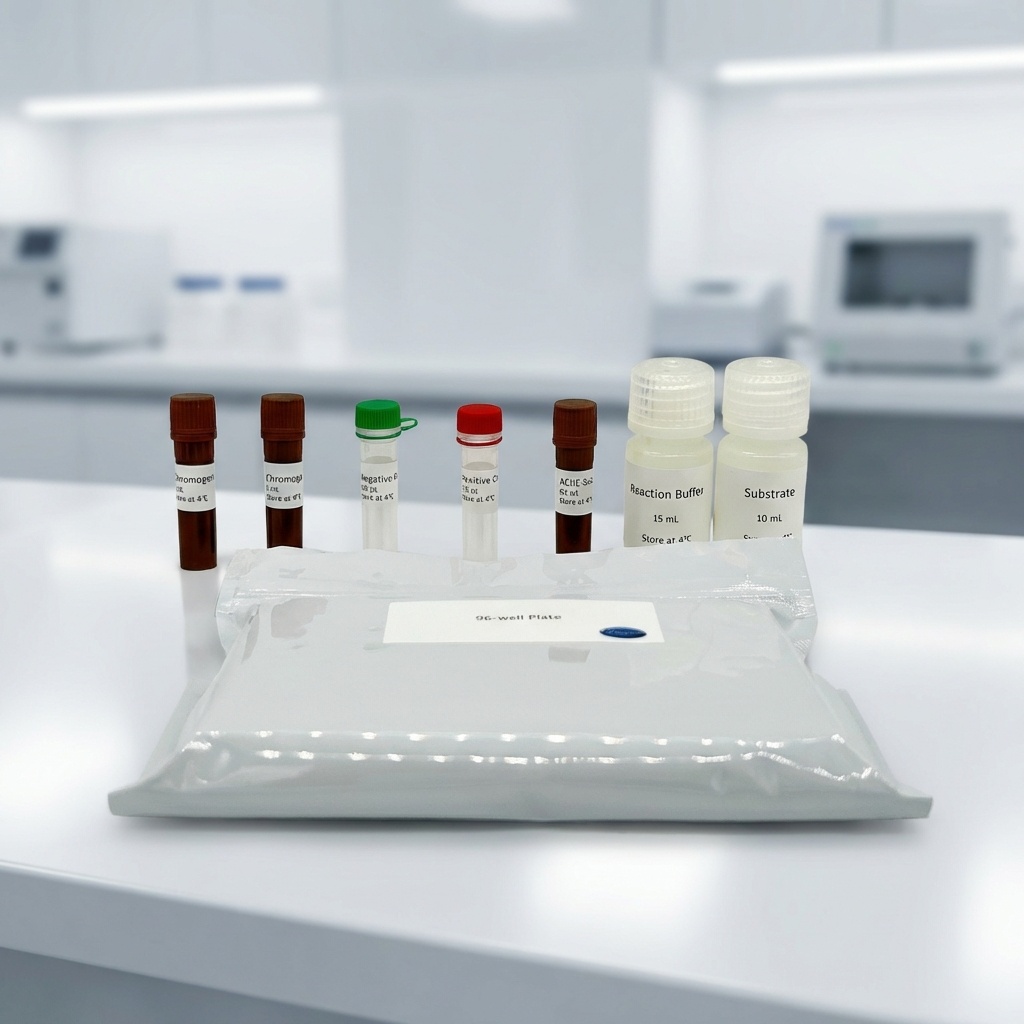
- Substrate Solution: 10 mL (store at 2–8 °C)
- Chromogen Solution: 2 mL (2–8 °C)
- Reaction Buffer: 15 mL (2–8 °C)
- AChE Solution, eel or tick according to the version ordered: 0.2 mL (2–8 °C)
- Positive Control: 100 µL (2–8 °C)
- Negative Control: 100 µL (2–8 °C)
- 96-well plate: 1 each (room temperature)
You will also need: micropipettes with disposable plastic tips (25–1000 µL); a multichannel pipette, stepper pipette or electronic repeating pipette (50–250 µL) with disposable tips; a microtiter plate reader (405–450 nm); and a timer.
Who It’s For
This kit suits research laboratories that need a quick, plate-based measure of AChE inhibition, including:
- Medicinal chemistry and drug discovery groups screening candidate AChE inhibitors.
- Environmental and agricultural labs studying organophosphate and carbamate compounds, which act by inhibiting AChE.
- Tick and pest-control researchers comparing how compounds affect tick AChE versus the widely used eel enzyme.
- Chemistry and chemical biology labs characterizing new compounds; the kit has already been cited in published research.
How to Use the Acetylcholinesterase Inhibition Assay
The order of addition is important. Summarized from the EZ2018 spec sheet:
- Add 50 µL of sample, positive control or negative control to duplicate wells.
- Add 100 µL of Reaction Buffer to each well.
- Add 2 µL of AChE Solution. For a no-enzyme control, add Reaction Buffer instead.
- Incubate for 5 minutes.
- Add 100 µL of Substrate Solution.
- Add 20 µL of Chromogen Solution.
- Incubate at room temperature for 10 minutes.
- Read absorbance at 412 nm and calculate percent inhibition against your controls.
Download the EZ2018 Acetylcholinesterase Inhibition Assay spec sheet (PDF) for the full protocol.
How It Works and Reading Results
Acetylcholinesterase (EC 3.1.1.7) hydrolyzes the neurotransmitter acetylcholine to choline and acetate. In this assay the enzyme acts on acetylthiocholine instead, releasing thiocholine, which reacts with DTNB to form a yellow adduct. The absorbance of that adduct is proportional to the amount of thiocholine formed, and therefore to AChE activity.
When an inhibitor is present, less thiocholine is produced and the signal drops. Comparing sample wells with your controls gives percent inhibition. For quantitative work, prepare standards of known concentration, subtract the blank standard’s absorbance from each reading, and fit a standard curve by linear regression.
Published Research
This kit has been used in: Sun S et al. Phosphorus fluoride exchange: Multidimensional catalytic click chemistry from phosphorus connective hubs. Chem. 2023;9(8):2128-2143.
Related Attogene Assays
- Acetylcholinesterase Detection Kit: measures AChE activity in cell, blood or tissue lysates.
- Acetylcholinesterase (Cattle Tick) Total Organophosphate Residue Detection Kit: AChE-based detection of organophosphate residues.
- Pesticide Detection Strip Test: a rapid strip format for pesticide screening.
- Tyrosinase Inhibitor Assay Kit: the same plate-based screening approach applied to tyrosinase.
Frequently Asked Questions
Which enzyme source should I choose, tick or eel?
Both versions follow the same acetylcholinesterase inhibition assay protocol. Eel AChE is a widely used reference enzyme, while the tick version suits studies focused on tick acetylcholinesterase. Select the version in the product options when ordering.
What does a lower absorbance mean?
Lower absorbance at 412 nm means less thiocholine was produced, which indicates stronger inhibition of AChE. Run samples in duplicate and compare them with the supplied controls.
Can I run a no-enzyme control?
Yes. Replace the 2 µL of AChE Solution with Reaction Buffer to measure the background signal of a well without enzyme.
Does the acetylcholinesterase inhibition assay give quantitative results?
The standard readout is percent inhibition. If quantitative results are required, set up a series of standards of known concentration, subtract the blank, and build a standard curve by linear regression.
How long does the assay take?
Once samples, buffer and enzyme are in the plate, the protocol needs a 5-minute incubation and a 10-minute room-temperature color step before reading.
How should the kit be stored?
Store all liquid components at 2–8 °C. The 96-well plate can be kept at room temperature.
For research use only. Not for use in diagnostic procedures. Questions? Call 512-333-1330 or email sales@attogene.com.