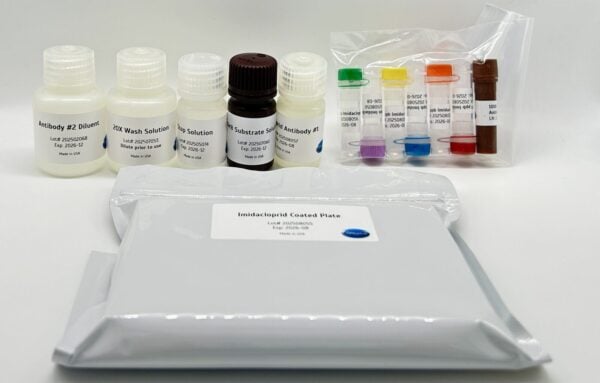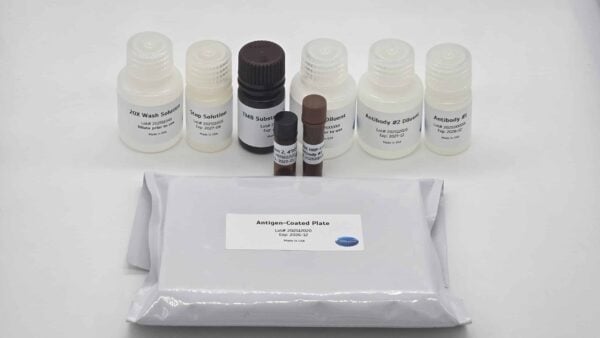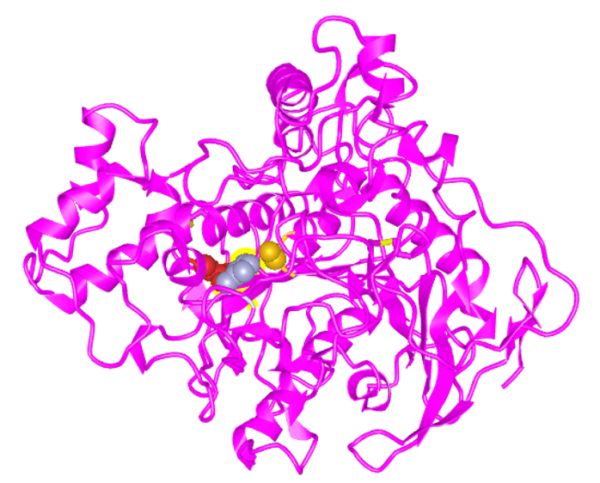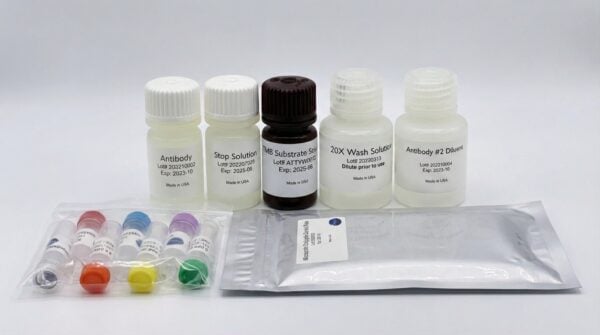


The Acetylcholinesterase Detection Kit is a colorimetric acetylcholinesterase activity assay for measuring AChE in cell, blood and tissue lysates and other biological research samples. Based on the Ellman method, it quantifies thiocholine released from acetylthiocholine using DTNB. The manual states a linear range of 10–600 units/liter and sensitivity as low as 10 µU of AChE in a sample. Catalog number EZ2021.
The kit provides reagents for 96 determinations, including an AChE positive control and a lysis buffer for sample preparation. Once the plate is set up, the assay needs a single 25-minute room-temperature incubation before reading.
Key Features
- Ellman chemistry: AChE hydrolyzes acetylthiocholine, and the thiocholine formed reacts with DTNB to produce a colored product in proportion to AChE activity.
- Sample prep included: 50 mL of AChE Lysis Buffer for preparing cell, blood or tissue lysates.
- Positive control: AChE at 10 Units/µL, which can also be used to prepare spiked standards in a negative extract.
- Wide linear range: 10–600 units/liter, with sensitivity down to 10 µU of AChE.
- Minimal sample: only 2 µL of lysate per well.
- Simple endpoint format: one 25-minute incubation at room temperature, then a single plate read.
What’s in the Kit
Each acetylcholinesterase activity assay kit includes:
- AChE Positive Control (10 Units/µL): 100 µL (store at -15 to -25 °C)
- Chromogen Solution (DTNB): 1.5 mL x 2 (2–8 °C)
- Reaction Buffer 1: 18 mL (room temperature)
- Reaction Buffer 2: 2.6 mL (room temperature)
- Substrate (S), acetylthiocholine: 700 µL (2–8 °C)
- AChE Lysis Buffer: 50 mL (room temperature)
- 96-well plate: 1 (room temperature)
You will also need: a microplate reader, a vortex mixer, pipettes (10 µL, 20 µL, 100 µL, 1000 µL), a refrigerated microcentrifuge capable of 14,000 x g, ice, and a protein assay of your choice for measuring lysate concentration.
Who It’s For
- Neuroscience and pharmacology labs measuring AChE activity in tissue or cultured cell lysates.
- Toxicology and ecotoxicology groups using AChE activity as a research biomarker of organophosphate or carbamate exposure in study organisms.
- Agricultural and pesticide researchers comparing enzyme activity across treatments.
- Assay development teams that need a positive-control-backed AChE activity readout in a 96-well format.
Sample Preparation
- Homogenize 8 million cells, 5 µL of blood, or 50 mg of tissue in 500 µL of ice-cold AChE Lysis Buffer.
- Keep on ice for 10 minutes.
- Centrifuge at 14,000 x g for 5 minutes at 4 °C, then collect the supernatant.
- Measure protein concentration with your preferred method; the manual recommends 1–2.5 µg/µL.
- Use lysates immediately, or store them at -80 °C.
How to Use the Acetylcholinesterase Activity Assay
Summarized from the EZ2021 manual. Use a new pipette tip for each step and each well:
- Add 167 µL of Reaction Buffer 1 to each well.
- Add 31 µL of Chromogen Solution.
- Add 2 µL of sample, AChE Lysis Buffer as a blank, or AChE Positive Control.
- Add 25 µL of Reaction Buffer 2.
- Add 7 µL of Substrate (S) and mix by pipetting up and down 3–4 times.
- Incubate at room temperature for 25 minutes.
- Read absorbance on a microplate reader.
The buffers and chromogen can be combined in a master mix, prepared with 10% overage. Download the Acetylcholinesterase Detection Kit manual (PDF) for the full protocol.
Controls and Reading Results
Color development is proportional to thiocholine formation, and therefore to AChE activity in the well. Run a blank and the AChE Positive Control on every plate, and include a sample background control when your matrix may contribute color.
For quantitation, the manual recommends running standards with each set of unknowns. Standards are not supplied, but the AChE Positive Control can be diluted into a negative extract to prepare spiked standards. Read sample activity from the resulting standard curve, staying within the 10–600 units/liter linear range.
Related Attogene Assays
- Acetylcholinesterase Inhibition Assay (Tick or Eel): a dedicated plate-based screen for AChE inhibitors.
- Acetylcholinesterase (Cattle Tick) Total Organophosphate Residue Detection Kit: AChE-based detection of organophosphate residues.
- Pesticide Detection Strip Test: a rapid strip format for pesticide screening.
- Alkaline Phosphatase Assay Kit: colorimetric ALP activity in cell culture samples.
Frequently Asked Questions
What samples can I test with this acetylcholinesterase activity assay?
The manual describes lysates prepared from cells, blood or tissue, and also lists serum, plasma and other biological samples. All samples are for research use only.
How sensitive is the kit?
The manual states a linear range of 10–600 units/liter in the 96-well plate and sensitivity as low as 10 µU of acetylcholinesterase in a sample.
How much sample do I need?
Each well uses 2 µL of lysate. The manual recommends lysate protein concentrations of 1–2.5 µg/µL; dilute more concentrated lysates before testing.
Can I use this kit to screen AChE inhibitors?
The manual notes that inhibitors can be screened using the AChE Positive Control. For a kit built around inhibitor screening, with eel or tick enzyme and dedicated controls, see the Acetylcholinesterase Inhibition Assay linked above; this acetylcholinesterase activity assay is optimized for measuring enzyme activity in samples.
How should I store the kit and my lysates?
Store the AChE Positive Control at -15 to -25 °C; the Chromogen Solution and Substrate at 2–8 °C; and the buffers and plate at room temperature. Keep prepared lysates at -80 °C if they are not used immediately.
For research use only. Not for use in diagnostic procedures. Questions? Call 512-333-1330 or email sales@attogene.com.