

The Attogene 2,4′-DDT ELISA Kit (EL2062) is a competitive DDT ELISA kit for quantitative analysis of 2,4′-DDT in water samples. It has an overall sensitivity of about 2 ppb, a recommended standard curve from 5 to 200 ppb, and a total incubation time of 75 minutes on a 96-well strip plate read at 450 nm.
DDT (dichlorodiphenyltrichloroethane) is a synthetic organochlorine insecticide once used widely for agriculture and mosquito control. The US EPA banned most agricultural uses in 1972, but DDT is chemically stable and persistent, so it can remain detectable in the environment long after application.
Key Features
- Quantitative results: recommended standards at 0, 5, 10, 20, 45 and 200 ppb.
- Flexible calibration: a 10 ppm 2,4′-DDT stock (200 µL in 100% methanol) that you dilute to the curve you need.
- Ready-made diluent: 30 mL of Sample Diluent, which also serves as the zero standard.
- Fast workflow: two 30-minute incubations and a 15-minute substrate step, 75 minutes in total.
- Flexible format: 96-well microtiter plate in 12 strips of 8 wells.
- Reproducible: accuracy in water of 80 ± 10% and a CV below 10%.
What’s in the Kit
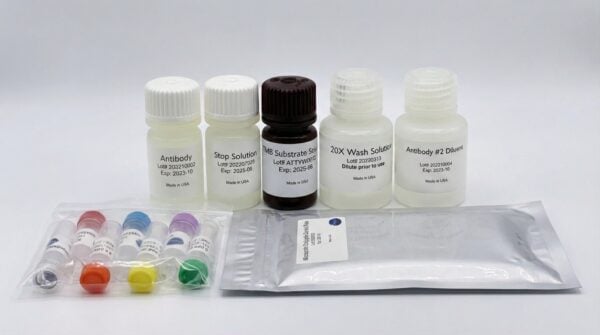
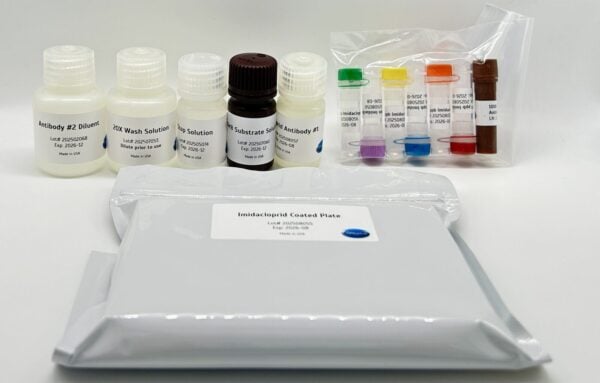
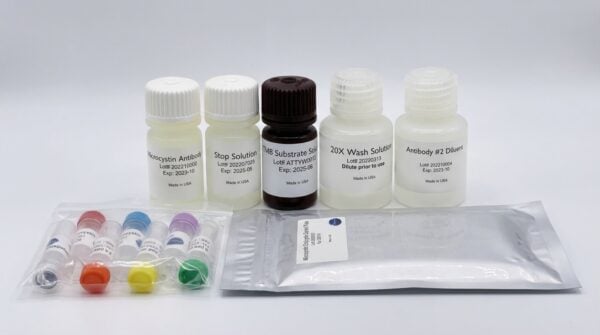
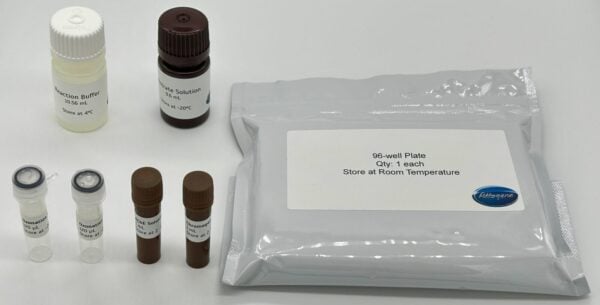
Each DDT ELISA kit includes:
- 96-well microtiter plate pre-coated with DDT (12 strips × 8 wells)
- 2,4′-DDT standard, 200 µL of 10 ppm in 100% methanol
- DDT Antibody #1, 11 mL
- 100X HRP-conjugated Antibody #2, 0.25 mL
- Antibody #2 Diluent, 20 mL
- 20X Wash Solution, 28 mL
- TMB Substrate Solution, 12 mL
- Stop Solution, 14 mL
- Sample Diluent / Zero Standard, 30 mL
You will also need: an ELISA plate reader (450/630 nm) such as the Chromate 4300 microplate reader, deionized water, methanol, a homogenizer, a vortex mixer, a centrifuge, a timer, a wash bottle, glass vials for the standard dilutions, 50 mL and 2 mL polystyrene centrifuge tubes, micropipettes (20–200 µL and 100–1000 µL) and a 300 µL multichannel pipette.
Who It’s For
- Environmental testing labs screening surface water, groundwater and source water for legacy organochlorine pesticides.
- Water utilities and monitoring programs that need a fast screen before confirmatory analysis.
- Researchers studying DDT persistence and transport in the environment.
Preparing the Standards
Prepare standards in glass vials using the Sample Diluent:
- Add 490, 387.5, 277.8, 250 and 250 µL of Sample Diluent to five vials.
- Add 10 µL of the 10 ppm stock to the 490 µL vial to make 200 ppb.
- Transfer 112.5 µL of 200 ppb into the 387.5 µL vial to make 45 ppb.
- Transfer 222.2 µL of 45 ppb into the 277.8 µL vial to make 20 ppb.
- Transfer 250 µL of 20 ppb into a 250 µL vial to make 10 ppb, then 250 µL of 10 ppb into the last vial to make 5 ppb.
The Sample Diluent alone (1X PBS with 10% methanol) is the 0 ppb standard.
How to Use the DDT ELISA Kit
- Make sure water samples are free of particles and adjusted to a neutral pH. Centrifuge or filter if needed.
- Bring all reagents to room temperature (20–28 °C) for at least 30 minutes.
- Add 50 µL of each standard or sample to the wells, in duplicate.
- Add 100 µL of Antibody #1, shake gently for 30 seconds, cover and incubate for 30 minutes at room temperature.
- Decant, wash 3 times with 250 µL of 1X Wash Solution and blot dry.
- Add 150 µL of freshly prepared 1X HRP-conjugated Antibody #2, shake for 30 seconds, cover and incubate for 30 minutes at room temperature.
- Wash 3 times as before and blot dry.
- Add 100 µL of TMB Substrate and incubate covered for 15 minutes at 25 °C.
- Add 100 µL of Stop Solution and read absorbance at 450 nm within 5 minutes.
Full instructions and precautions are in the 2,4′-DDT ELISA Kit manual (PDF).
Reading Results
The assay is competitive: DDT in the sample competes with DDT coated on the plate for the antibody, so more DDT means less color. Calculate B/B0 % by dividing the mean absorbance of each standard and sample by the zero standard absorbance and multiplying by 100. Plot B/B0 % against the log of concentration in ppb, read sample values from the curve and multiply by any dilution factor.
A zero-standard absorbance below 1 suggests that one or more reagents may be bad. Discard TMB Substrate that has turned blue before use.
Frequently Asked Questions
What samples can I test with this DDT ELISA kit?
The manual covers water samples. For soil, sediment or food matrices, contact Attogene about extraction before testing.
Does the kit detect other DDT isomers or metabolites such as DDE and DDD?
The manual does not include cross-reactivity data. Contact Attogene if you need to measure compounds other than 2,4′-DDT.
What if a sample is above the top standard?
Dilute it with the provided Sample Diluent, rerun it, and multiply the result by the dilution factor.
How should the DDT ELISA kit be stored?
Store at 2–8 °C, away from light, and do not freeze. Shelf life is 12 months or until the expiration date.
Is there a discount for larger orders?
Yes. Orders of 5 kits qualify for a discount. Contact sales@attogene.com or call 512-333-1330 for details.
Testing for other pesticides? See the Atrazine ELISA Kit, the Imidacloprid ELISA Kit, the Organophosphorus ELISA Kit, the Pesticide ELISA Kit Menu, or the full Food Safety ELISA Kit Menu.
For research use only. Not for use in diagnostic procedures. Questions? Call 512-333-1330 or email sales@attogene.com.