
The Organophosphorus ELISA Kit (EL2022-08) is a competitive enzyme immunoassay for quantitative analysis of organophosphate pesticides in liquid samples such as water and wastewater and in solid samples such as wheat. The 96-well kit uses five standards covering a 5 to 40 ppb curve, an overall sensitivity of 5 ppb, and 75 minutes of total incubation, read at 450 nm.
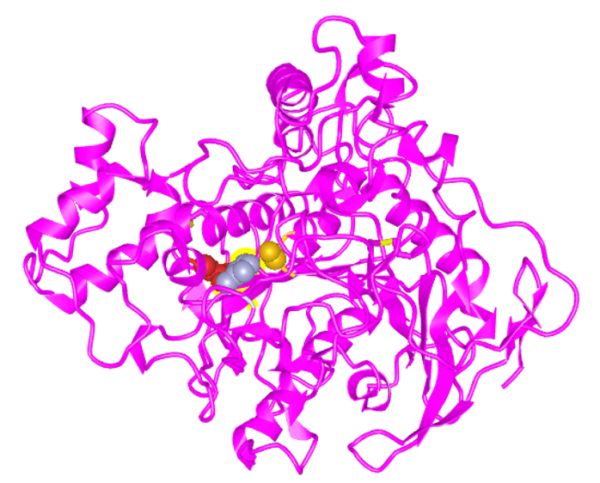
Organophosphates (OPs) are a class of pesticides that act by inhibiting the acetylcholinesterase enzyme, and regulatory guidelines limit their levels in food and water. Most OPs are supplied in their precursor organothiophosphate form, for example malathion, diazinon, chlorpyrifos, azinphos, dimethoate, terbufos and phosmet. Attogene’s kit is designed to detect organothiophosphates, the main form of these compounds when they are applied in the field.
Key Features
- Targets organothiophosphates: designed around the field-applied form of common OP pesticides.
- Multiple matrices: water, wastewater and liquid media, plus grain such as wheat, with sample preparation steps in the manual.
- Sensitivity: overall sensitivity of 5 ppb and a grain detection limit of 5 ppb; kit CV below 10%.
- Five calibrators: 0, 5, 10, 15 and 40 ppb, color coded by cap.
- Short protocol: two 30-minute incubations and a 15-minute substrate step at room temperature.
- Storage: 2–8 °C, do not freeze; 12-month storage period.
What’s in the Kit
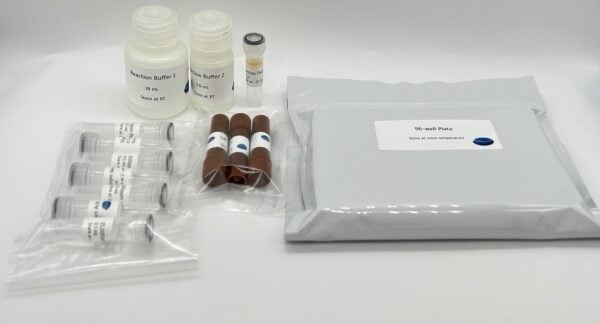
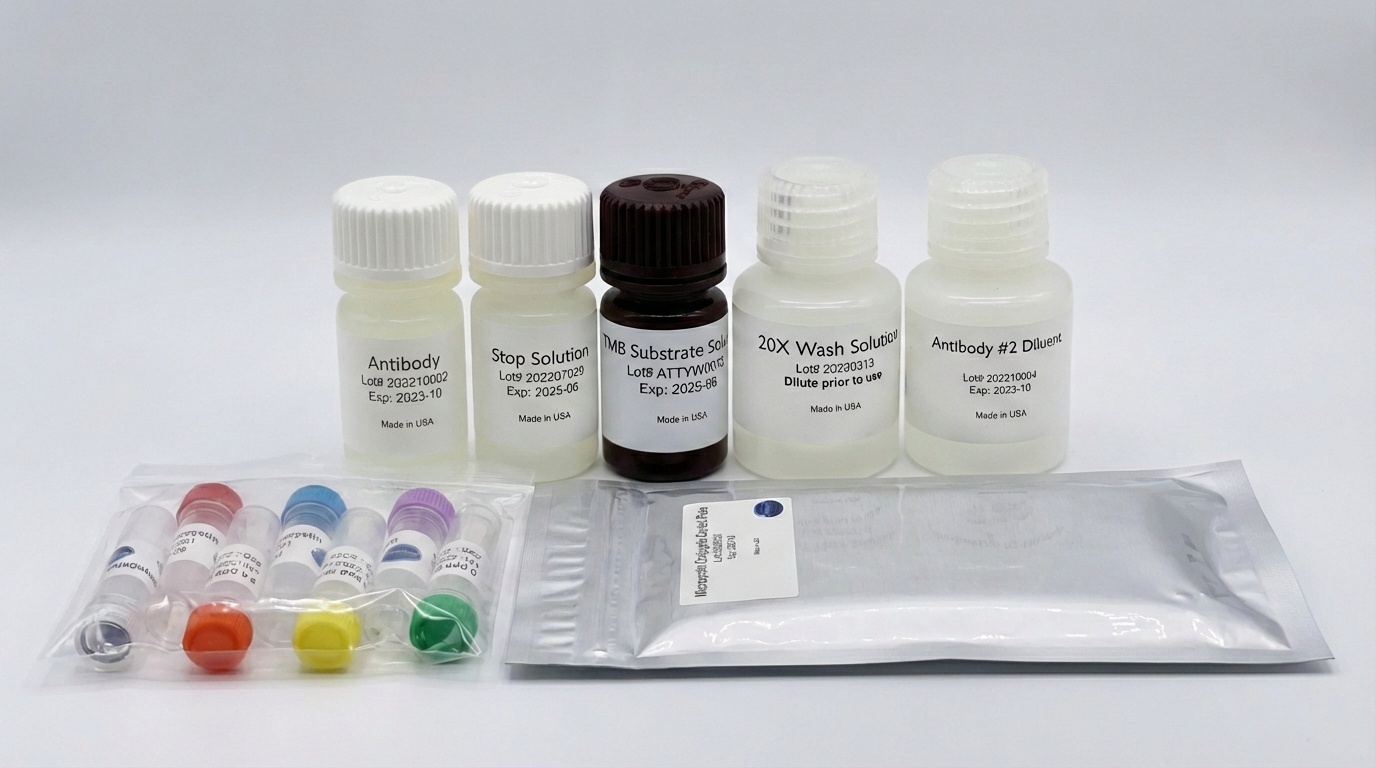
Each organophosphorus ELISA kit includes:
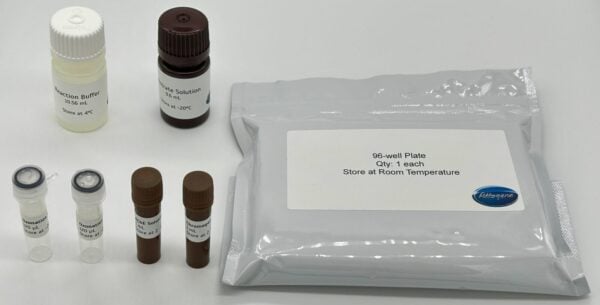
- Microtiter plate with 96 wells coated with organophosphate
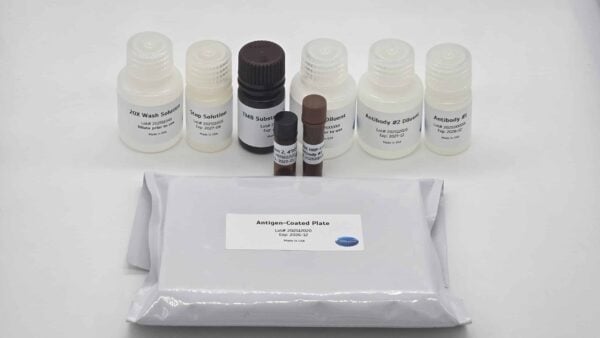
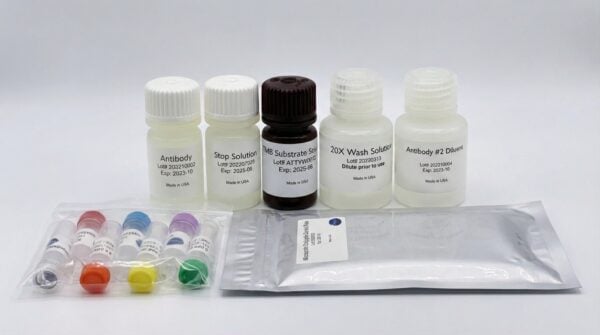
- Organophosphate standards, 5 vials × 0.8 mL: 0 ppb (green cap), 5 ppb (yellow), 10 ppb (blue), 15 ppb (orange), 40 ppb (red)
- Organophosphate Antibody#1, 11 mL
- 100X HRP-conjugated Antibody#2, 0.25 mL
- Antibody#2 Diluent, 20 mL
- 20X Wash Solution, 28 mL
- TMB Substrate Solution, 12 mL
- Stop Solution, 14 mL
You will also need: an ELISA plate reader (450 nm/630 nm), deionized water, methanol, vortex mixer, timer, wash bottle, 50 mL and 2 mL polystyrene centrifuge tubes, micropipettes (20–200 µL and 100–1000 µL), and a 300 µL multipipette. A centrifuge or 1.2 µm syringe filters and a blender are needed for sample preparation.
Who It’s For
- Environmental and wastewater laboratories screening for OP pesticide residues
- Grain and agricultural research labs testing wheat and other cereals
- Academic and government researchers running pesticide monitoring studies
- Labs that want a plate-based screen ahead of instrumental confirmation
Sample Preparation
- Liquids (water, wastewater, liquid media): make sure the sample is free of particles and at neutral pH. If needed, centrifuge at 3000 × g for 5 minutes at room temperature or filter through a 1.2 µm syringe filter. Use 50 µL of the supernatant.
- Grain: homogenize in a blender for at least 3 minutes. Add 9.0 mL of 90% methanol/water to 1 g of homogenate and vortex for 2 minutes. Centrifuge at 3000 × g for 10 minutes, dilute the supernatant with Antibody#2 Diluent, and use 50 µL for the assay.
How to Use the Organophosphorus ELISA Kit
- Bring all reagents and microwells to room temperature (20–25 °C) for at least 30 minutes. Prepare 1X Wash Solution (1 part 20X concentrate to 19 parts deionized water) and fresh 1X HRP-conjugated Antibody#2 (1 part to 99 parts Antibody#2 Diluent).
- Number the well positions and run all standards and samples in duplicate.
- Add 50 µL of standard or prepared sample to each well, then 100 µL of Antibody#1. Shake gently for 30 seconds, cover and incubate 30 minutes at room temperature.
- Decant, wash three times with 250 µL of 1X Wash Solution and tap dry on absorbent paper.
- Add 150 µL of 1X HRP-conjugated Antibody#2, shake, cover and incubate 30 minutes. Wash three times as before.
- Add 100 µL of TMB Substrate Solution and incubate 15 minutes at 25 °C, covered.
- Add 100 µL of Stop Solution, mix gently and read at 450 nm within 5 minutes.
Full details are in the Organophosphorus ELISA Kit Manual (EL2022-08).
Reading Results
Organophosphates in the sample compete with plate-bound antigen for Antibody#1, so higher concentrations produce less color. Express each standard and sample as a percentage of the zero standard (B/B0 × 100%), plot against the log of standard concentration, and read concentrations from the curve, multiplying by the dilution factor. Samples with absorbance below the 40 ppb calibrator should be diluted to fit the 5–40 ppb range and rerun.
Frequently Asked Questions
Which pesticides does the organophosphorus ELISA kit detect?
It is designed to detect organothiophosphates, the precursor form in which most OPs are applied, such as malathion, diazinon, chlorpyrifos, azinphos, dimethoate, terbufos and phosmet. Contact us for compound-specific reactivity data.
Can I test grain samples?
Yes. The manual includes a methanol extraction for grain and lists a 5 ppb detection limit for grain.
How long does the assay take?
Incubations total 75 minutes, plus reagent warm-up, sample preparation and wash steps.
How should prepared samples be stored?
Treated samples can be held at 2–8 °C in the dark for up to 24 hours.
How do I know the reagents are still good?
Discard the substrate if it has changed color. A zero-standard absorbance below 0.5 at 450 nm indicates the reagents may have degraded.
Related ELISA Kits
Other Attogene pesticide residue kits include the Imidacloprid ELISA Kit, the Atrazine ELISA Kit and the Carbendazim ELISA Kit.
For research use only. Not for use in diagnostic procedures. Questions? Call 512-333-1330 or email sales@attogene.com.