
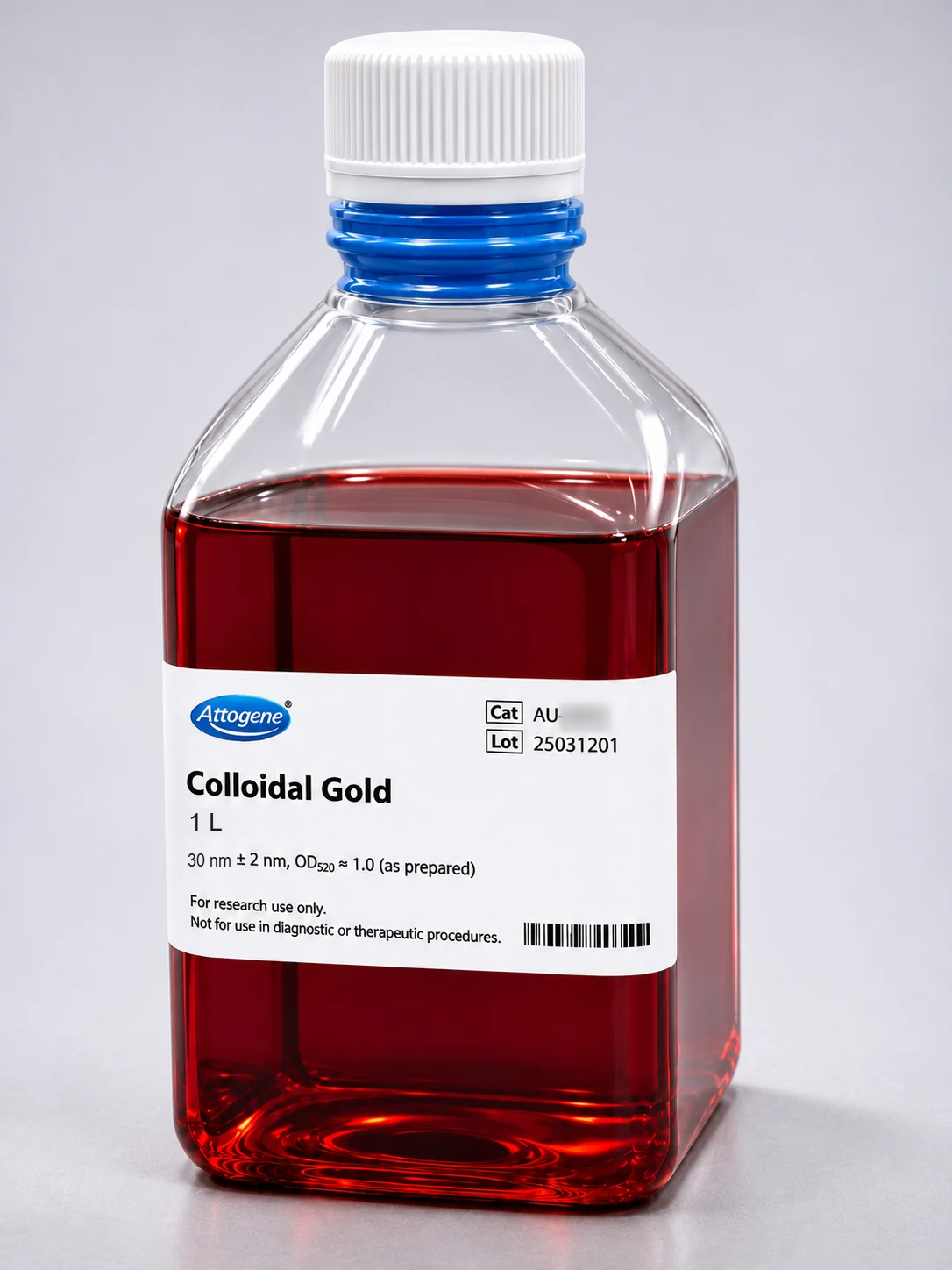
Colloidal Gold for Lateral Flow (30nm) is uniform, highly stable 30nm colloidal gold (catalog AU2013) for researchers and manufacturers who make their own lateral flow conjugates. The particles are 30 nm ± 1.5 nm in diameter with an absorption maximum of 519–521 nm, and Attogene can supply them from 1 OD to 100 OD.
A consistent conjugate starts with consistent gold. This product is made in Austin, Texas in Attogene’s own manufacturing facility, which allows rapid turnaround and batch-to-batch reliability, and it is functionally tested in lateral flow. Bulk pricing and manufacturing supply contracts are available.
Key Features
- Defined 30 nm size: 30 nm ± 1.5 nm, sitting between Attogene’s 10 nm and 40 nm particles.
- Narrow distribution: size CV below 12% and more than 95% spherical particles across Attogene’s colloidal gold line.
- Reproducible lots: ±2 nm batch-to-batch variation helps optimized conditions carry over from lot to lot.
- Stable colloid: −50 mV zeta potential, supplied at pH 7.5.
- Functionally tested in a lateral flow format.
- Scalable supply: four standard volumes, custom OD from 1 to 100, and supply contracts for manufacturing.
Specifications
Each 30nm colloidal gold order is supplied at 1 OD as standard. Specifications for the 1 OD product (catalog AU2013-01):
- Particle diameter: 30 nm ± 1.5 nm
- Absorption maximum: 519–521 nm
- Particles per mL: 1.3–2 × 10¹¹
- Gold concentration: 4.2–4.7 × 10⁻² mg/mL
- Molar concentration: 2.2–3.3 × 10⁻¹⁰ mol/L
- Zeta potential: −50 mV
- pH: 7.5
- Pack sizes: 30 mL, 100 mL, 500 mL and 1 L
- Storage: 2–25 °C. Do not freeze, as freezing irreversibly aggregates the particles.
Concentrated gold and larger quantities are available on request from sales@attogene.com.
Who It’s For
- Assay developers comparing particle sizes who want a mid-range option to test next to 10nm, 40nm and 60nm Colloidal Gold.
- Labs conjugating their own antibodies or proteins by passive adsorption.
- Manufacturers moving a prototype into production who need consistent lots and a supply agreement.
How to Use 30nm Colloidal Gold in Your Assay
Attogene’s Gold Conjugation Technical Guide describes a five-step passive adsorption workflow. In summary:
- Handle the gold correctly. Bring it to room temperature and shake vigorously for 30 seconds so the particles are fully dispersed.
- Clean up the antibody. Remove BSA, gelatin, glycerol, Tris, glycine and sodium azide by buffer exchange into 10 mM HEPES or another suitable buffer, then confirm the concentration by A280.
- Find the right pH. Mix 100 µL of 1 OD gold with 10 µL of 22 mM buffer (pH 5.5 to 10 in 0.5-unit steps) and 10 µL of antibody at 100 µg/mL. After 15 minutes, challenge with 25 µL of 1.5 M NaCl. Stable wells stay ruby red; aggregated wells turn purple, then gray-blue.
- Find the minimum antibody loading at that pH with an antibody dilution series and the same salt challenge.
- Scale up and purify. At the chosen pH and antibody amount, add antibody to the gold (never gold to antibody), block with BSA and wash away free antibody by centrifugation or tangential flow filtration.
- Store and check the conjugate, then confirm function with a dot-spot test on blank strips.
The guide’s centrifugation table lists 20, 40 and 60 nm particles but not 30 nm, so set pelleting conditions for 30 nm conjugates empirically. The guide’s general advice applies: start at a lower speed and adjust so the supernatant is nearly clear and the pellet stays soft. Download the 30 nm spec sheet (AU2013-01) and the Gold Conjugation Technical Guide (PDF).
Choosing Between Gold Sizes
Attogene’s own testing shows that particle size can change the visual performance of a lateral flow assay. In the article The Impact of Colloidal Gold on Lateral Flow Optimization, gold conjugates of different sizes gave different results in the same competitive format, and the amount of gold and the reader also mattered. The practical takeaway is to treat size as a variable and screen it with your antibody pair.
At 1 OD, the 30 nm product carries 1.3–2 × 10¹¹ particles/mL, fewer than the 10 nm product and more than the 40 nm and 60 nm products. Optimize pH and antibody loading for each size you test.
Related products: Protein A Colloidal Gold and Streptavidin Colloidal Gold are ready-made conjugates for early feasibility work, and the Universal Lateral Flow Assay Kit (Particles Not Included) is a nucleic acid dipstick kit that ships without detection particles, so you supply your own.
Frequently Asked Questions
Can I order 30nm colloidal gold at a higher OD?
Yes. The standard product is 1 OD, but Attogene can supply 30nm colloidal gold from 1 OD to 100 OD. Email sales for a quote.
What volumes are available?
30 mL, 100 mL, 500 mL and 1 L are offered online. Bulk pricing and manufacturing supply contracts are available for larger needs.
How should the gold be stored?
At 2–25 °C. Never freeze it. Shake for 30 seconds before each use.
Which buffer should I start with for conjugation?
Screen pH first. Attogene notes that many monoclonal antibodies conjugate well at pH 7.5, and HEPES is convenient because it dissolves near pH 7.5 with little titration.
Do you offer conjugation as a service?
Yes. Attogene’s lateral flow services cover colloidal gold conjugation through prototype manufacturing, validation and scale-up.
For research use only. Not for use in diagnostic procedures. Questions? Call 512-333-1330 or email sales@attogene.com.