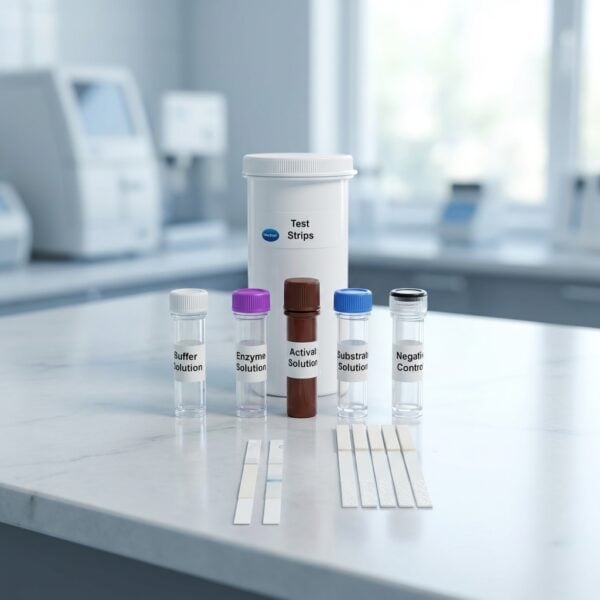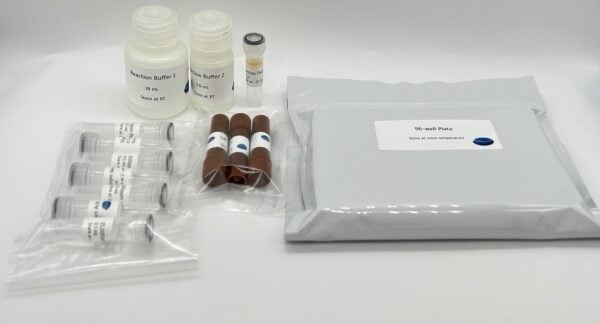


The Imidacloprid ELISA Kit (EL2022-06) is a competitive enzyme immunoassay for quantitative analysis of imidacloprid, the most widely used neonicotinoid insecticide, in water. The 96-well kit includes six standards covering a 0.5 to 10 ppb curve and uses 75 minutes of total incubation time, with results read at 450 nm on a standard plate reader.
Neonicotinoids are systemic insecticides used to control sucking and chewing insects such as aphids, whiteflies, leafhoppers and some beetles. Because imidacloprid is highly water soluble, concerns include wind drift, contamination of surface and groundwater, and toxicity to honeybees and other beneficial organisms. Like other pesticides, part of each application can evaporate or remain in soil, and residues can be detected in rain, surface water and groundwater.
Key Features
- Quantitative or qualitative: suitable for quantitative and/or qualitative detection of imidacloprid; positive samples should be confirmed by GC/MS, HPLC or other conventional methods.
- Six calibrators: 0, 0.5, 1, 2, 5 and 10 ppb, color coded by cap.
- Performance: 80 ± 10% accuracy in water and a kit CV below 10%.
- Short protocol: two 30-minute incubations and a 15-minute substrate step at room temperature.
- Familiar format: 96-well microtiter plate, read at 450 nm (450/630 nm reader).
- Storage: 2–8 °C, do not freeze; 12 months or until the expiration date.
What’s in the Kit
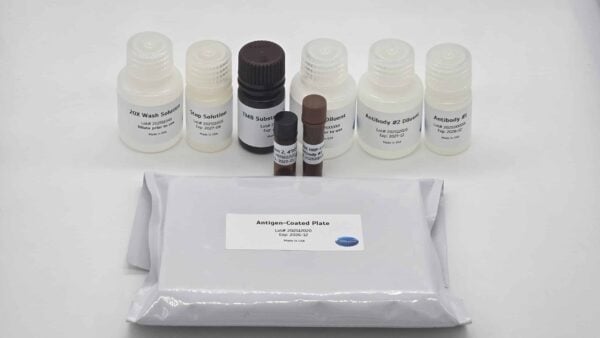
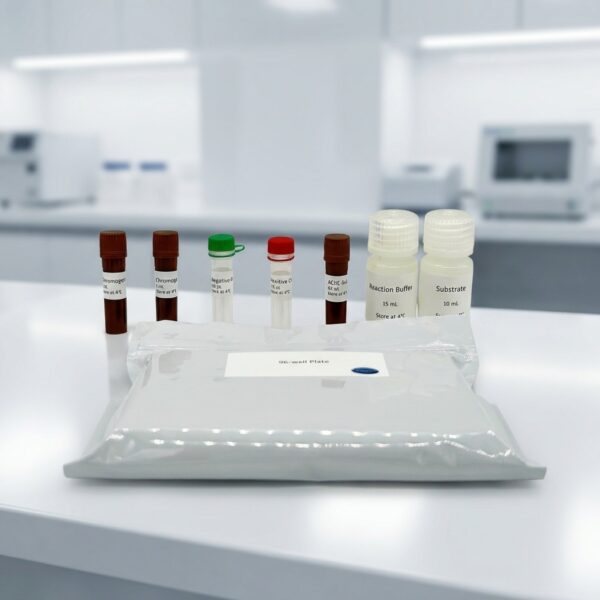
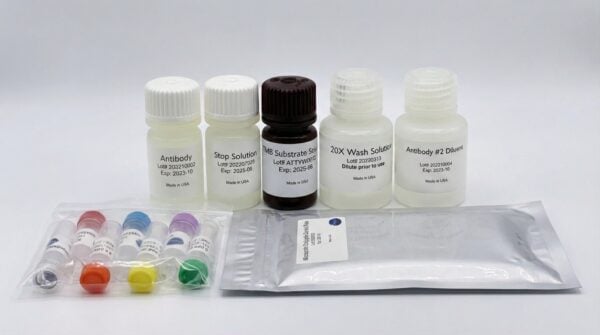
Each imidacloprid ELISA kit includes:
- Microtiter plate with 96 wells coated with imidacloprid
- Imidacloprid standards, 6 vials × 0.8 mL: 0 ppb (green cap), 0.5 ppb (purple), 1 ppb (yellow), 2 ppb (blue), 5 ppb (orange), 10 ppb (red)
- Imidacloprid Antibody#1, 11 mL
- 100X HRP-conjugated Antibody#2, 0.25 mL
- Antibody#2 Diluent, 20 mL
- 20X Wash Solution, 28 mL
- TMB Substrate Solution, 12 mL
- Stop Solution, 14 mL
You will also need: an ELISA plate reader (450 nm/630 nm), deionized water, vortex mixer, centrifuge, timer, wash bottle, 50 mL and 2 mL polystyrene centrifuge tubes, micropipettes (20–200 µL and 100–1000 µL) with tips, and a 300 µL multichannel pipette.
Who It’s For
- Environmental and water quality labs monitoring neonicotinoid residues
- Agricultural researchers studying runoff, leaching and persistence
- Pollinator and ecotoxicology research groups
- Labs that need a plate-based screen ahead of GC/MS or HPLC confirmation
How to Use the Imidacloprid ELISA Kit
- Bring all reagents and microwells to room temperature (20–25 °C) for at least 30 minutes. Prepare 1X Wash Solution (1 part 20X concentrate to 19 parts deionized water) and fresh 1X HRP-conjugated Antibody#2 (1 part to 99 parts Antibody#2 Diluent).
- Number the well positions and run all standards and samples in duplicate. Return unused wells to the zip-lock bag at 2–8 °C.
- Add 50 µL of standard or sample to each well, then 100 µL of Antibody#1. Shake gently for 30 seconds, cover and incubate 30 minutes at room temperature.
- Decant, wash three times with 250 µL of 1X Wash Solution and tap dry on absorbent paper.
- Add 150 µL of 1X HRP-conjugated Antibody#2, shake, cover and incubate 30 minutes at room temperature. Wash three times as before.
- Add 100 µL of TMB Substrate Solution and incubate 15 minutes at 25 °C, covered.
- Add 100 µL of Stop Solution, mix gently and read absorbance at 450 nm within 5 minutes.
Complete instructions are in the Imidacloprid ELISA Kit Manual (EL2022-06).
How It Works and Reading Results
Imidacloprid in the sample and imidacloprid antigen compete for binding to Antibody#1, which is captured on the well walls. After washing, an HRP-conjugated secondary antibody is added and the TMB substrate turns blue in proportion to the bound enzyme. The more imidacloprid in the sample, the weaker the color.
Express each standard and sample as a percentage of the zero standard (B/B0 × 100%), plot against the log of standard concentration, and read sample concentrations from the curve. Multiply by any dilution factor. If a sample’s absorbance is lower than the 10 ppb calibrator, dilute it to fit the 0.5–10 ppb range and rerun.
Frequently Asked Questions
What samples can the imidacloprid ELISA kit test?
The manual lists water. Accuracy figures (80 ± 10%) are given for water samples.
What is the detection limit?
The manual lists a detection limit of 3 ppb for water, while the standard curve extends from 0.5 to 10 ppb. Contact us if you need guidance on reporting results near the low end of the curve.
Do positive results need confirmation?
Yes. The manual recommends confirming positive samples by GC/MS, HPLC or another conventional method.
How long does the assay take?
Incubations total 75 minutes, plus 30 minutes to warm reagents and time for washes and setup.
How should the kit be stored?
At 2–8 °C; do not freeze. Treated samples can be kept at 2–8 °C in the dark for 24 hours. Do not mix reagents from different lots.
Related ELISA Kits
For other pesticide residues, see the Atrazine ELISA Kit, the Organophosphorus ELISA Kit and the Carbendazim ELISA Kit.
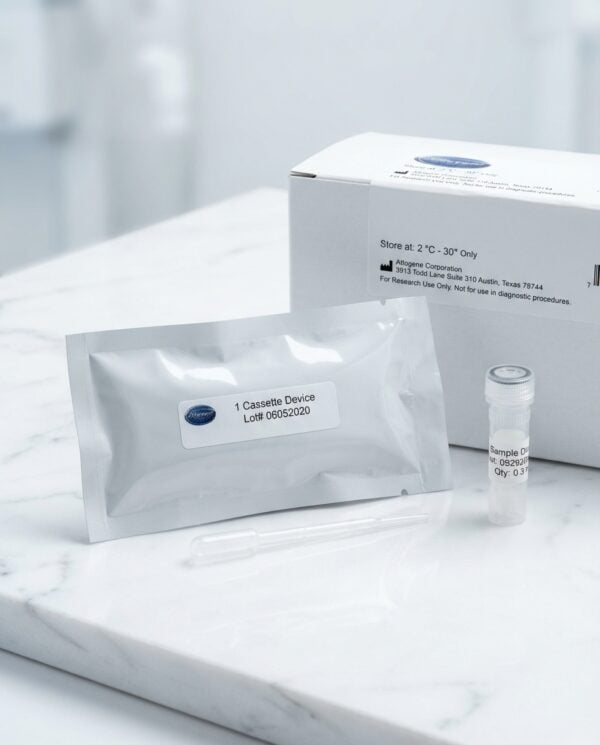
For research use only. Not for use in diagnostic procedures. Questions? Call 512-333-1330 or email sales@attogene.com.