

Attogene Formaldehyde Detection Kit (catalog EZ2012) is a colorimetric formaldehyde detection assay that measures formaldehyde (HCHO) from 0.1 to 1.5 mg/l by comparing a sample’s color against a printed color card. Each kit provides 100 determinations, all components are stored at room temperature, and the reaction takes 5 minutes at room temperature with no instrument required.
Formaldehyde reacts with the kit’s Formaldehyde Reaction Powder (FRP) to form a purple-red tetrazine. The deeper the color, the higher the formaldehyde concentration. Separate instructions cover aqueous liquids, solid foods and feed, and milk.
Key Features
- Seven-step color scale: 0.1 / 0.25 / 0.4 / 0.6 / 0.8 / 1.0 / 1.5 mg/l HCHO.
- Fast: 30 seconds of mixing and a 5-minute incubation at room temperature.
- 100 determinations per kit: buffer and reaction powder supplied for 100 reactions.
- Room-temperature storage: no refrigeration needed for any kit component.
- Several sample types: aqueous liquids, milk, and solids such as fish, shrimp, meat, tofu, vegetables and feed.
- Positive control included: a 375 mg/l formaldehyde spike for preparing positive controls.
- Optional digital reading: results can also be read with a Nix QC color sensor.
What’s in the Kit
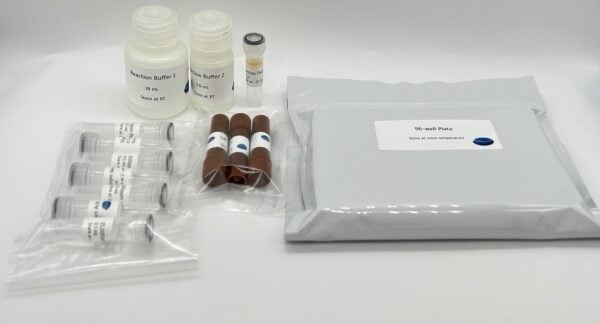
Each formaldehyde detection assay kit includes:
- BA (Buffering Agent), 3 x 8 mL dropper bottles
- FRP (Formaldehyde Reaction Powder), 2 x 1.5 g in foil pouch bags
- 1 microspoon
- 2 sample vials
- 1 graduated 5-mL syringe
- Formaldehyde spike (375 mg/l), 200 µL
- 1 color card
You will also need: distilled water for negative controls, dilutions, extraction of solid samples and rinsing, and a cutting tool for solid samples. For digital reading, a Nix QC color sensor with a Nix Liquid Adapter and glass cuvette is required.
Who It’s For
- Food safety and QC labs screening seafood, meat, tofu, vegetables and milk for formaldehyde added as a preservative.
- Feed producers and testing labs checking feed samples.
- Environmental and industrial labs testing aqueous liquid samples.
- Field and inspection teams that need a portable test without lab instruments.
How to Use the Formaldehyde Detection Assay
Aqueous liquids and milk:
- Remove the cap from a sample vial.
- Using the graduated syringe, add 5 mL of sample, distilled water (negative control) or spiked sample (positive control).
- Add 5 drops of BA.
- Add 1 level microspoon of FRP.
- Cap the vial, tighten and mix by hand for 30 seconds.
- Incubate at room temperature for 5 minutes.
- Read the result in mg/l HCHO by comparing the vial with the color card.
Solids (fish, shrimp, meat, tofu, vegetables, feed): cut the sample into small pieces, add roughly 5 g to a sample vial with 5 mL of distilled water, and shake vigorously by hand for 3 minutes. Transfer 5 mL of the supernatant to a new vial, then continue from the BA step above.
Full instructions are in the Formaldehyde Detection Assay Kit manual (PDF) and the milk manual (PDF).
Reading Results and Controls
- Read on time: the color may keep changing after the 5-minute reaction time; this later change should not be used for the measurement.
- Above the scale: if the color matches or is darker than the 1.5 mg/l color, a reading of 1.5 mg/l may understate the true value. Dilute fresh sample stepwise with distilled water, repeat until the result is below 1.5 mg/l, and multiply by the dilution factor.
- Controls: run standards and a known negative with each sample set so results are comparable across days, times and users. Adding 20 µL of the 375 mg/l spike to a 5 mL reaction gives 1.5 mg/l formaldehyde.
- Digital option: with a Nix QC sensor, the reacted solution is poured into the Nix cuvette and the software matches its L, A, B values to the closest color card interval. See the Nix Color Sensor and Attogene Formaldehyde Kit white paper.
Where Formaldehyde Is Found
Formaldehyde (CH2O) is mainly used to make industrial resins and also serves as a preservative, disinfectant and biocide. Because of its toxicity and volatility, it poses a significant risk to human health. Common sources include:
- Resins in composite wood products such as hardwood plywood, particleboard and medium-density fiberboard
- Building materials and insulation
- Glues, permanent-press fabrics, paints, coatings, lacquers, finishes and paper products
- Preservatives in some medicines, cosmetics and consumer products such as dishwashing liquids and fabric softeners
- Fertilizers and pesticides
- Combustion by-products, including emissions from unvented fuel-burning appliances and cigarette smoke
Frequently Asked Questions
What range does the formaldehyde detection assay cover?
The color card covers 0.1 to 1.5 mg/l HCHO in seven steps. Samples above 1.5 mg/l can be diluted with distilled water and re-tested.
How long does the test take?
About 6 minutes for liquids: 30 seconds of mixing and a 5-minute incubation. Solid samples add a 3-minute extraction.
Can I test milk?
Yes. A dedicated milk manual describes adding 5 mL of milk directly to the sample vial and following the same reaction steps.
Do I need an instrument?
No. This formaldehyde detection assay is read by eye against the color card. A Nix QC color sensor can be used for a digital reading if preferred.
How should the kit be stored?
Store all components at room temperature. Reclose the FRP container right after use and return it to its foil pouch, and rinse the syringe and vials with distilled water only.
Do you offer other food and environmental test kits?
Yes. See our Benzoic Acid Detection Kit for preservative testing, the Pesticide Detection Strip Test, and the Carbon Dioxide Detection Kit.
For research use only. Not for use in diagnostic procedures. Questions? Call 512-333-1330 or email sales@attogene.com.