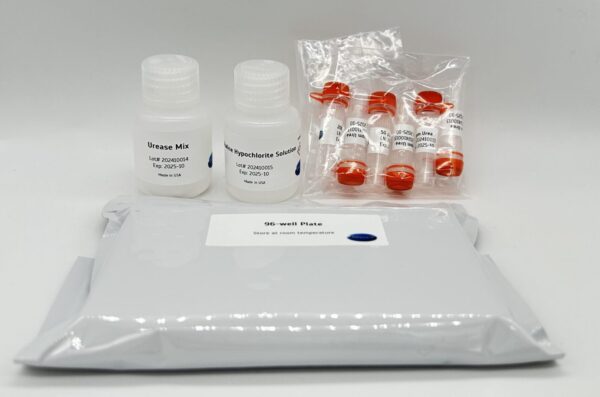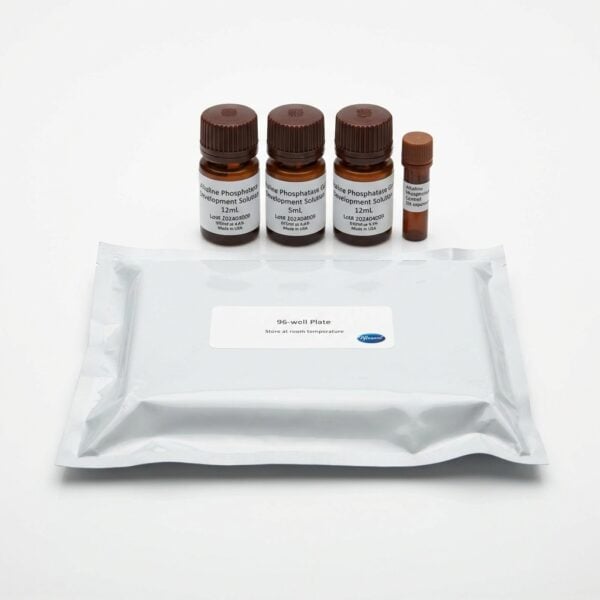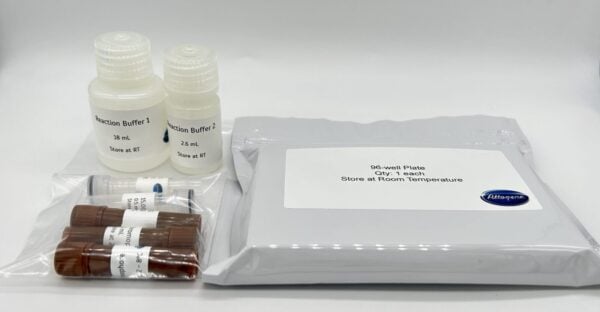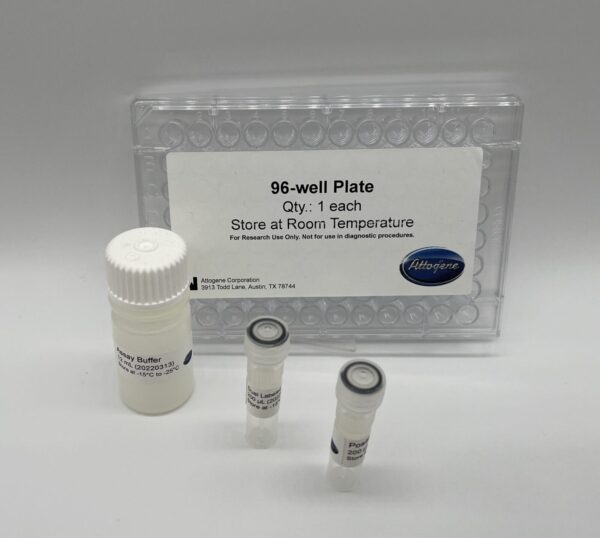


The Attogene Carbon Dioxide Detection Kit (catalog EZ2014-01) is a plate-based enzymatic carbon dioxide detection assay that measures CO2, as bicarbonate, in environmental samples. It is linear from 0 to 40 mmol/L with a sensitivity of 0.03 mmol/L, needs only 3 µL of diluted sample per well, and gives an endpoint result at 340 nm after a 5-minute incubation at 37 °C. The kit is configured for 96 determinations.
Two coupled enzyme reactions convert the CO2 signal into a drop in NADH absorbance, so results are read on a standard 96-well plate reader with a 340 nm filter.
Key Features
- Linear range: 0 to 40 mmol/L CO2.
- Sensitivity: 0.03 mmol/L, based on an instrument resolution of 0.001 absorbance units.
- Rapid: 5-minute incubation at 37 °C, then a single read.
- Small sample volume: 3 µL of 1:1 diluted sample per well.
- Calibrator included: a 30 mmol/L sodium bicarbonate standard and CO2-free water for the dilution series.
- Flexible format: 96-well plate layout suited to automated liquid handling.
What’s in the Kit
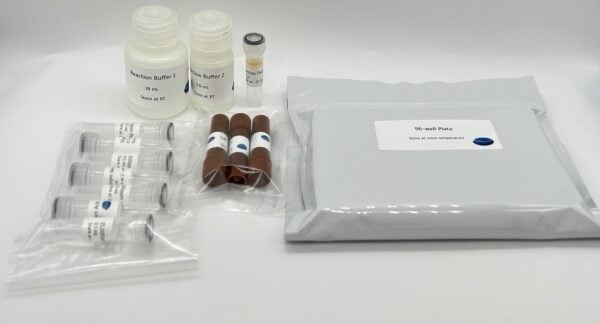
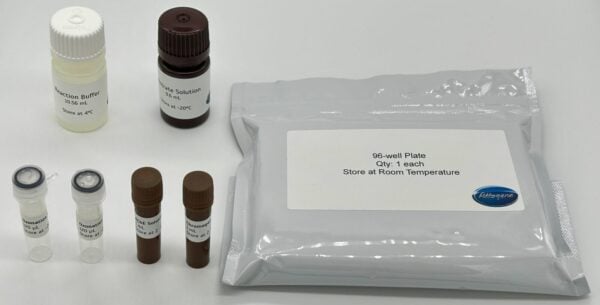
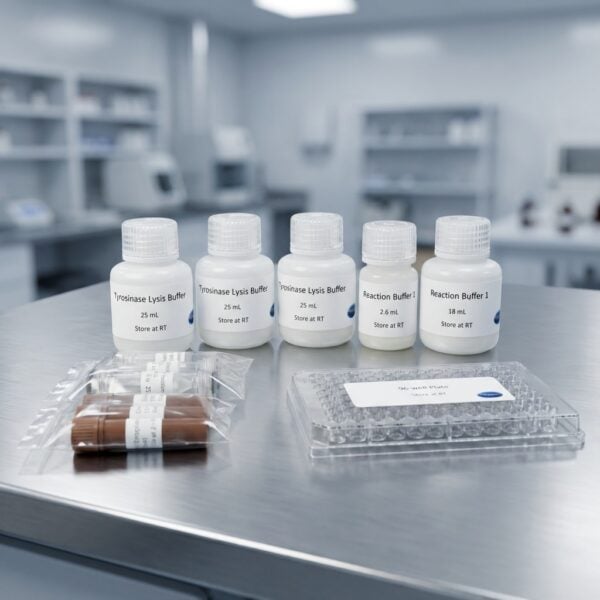
Each carbon dioxide detection assay kit includes:
- Carbon Dioxide Standard (30 mmol/L sodium bicarbonate), 1 mL, 2 to 8 °C
- CO2-free Water, 2 x 25 mL, 2 to 8 °C
- Carbon Dioxide Reagent, 4 vials, each reconstituted with 6 mL of CO2-free water, 2 to 8 °C
- Microtiter plate, 1
You will also need: micropipettes with disposable tips for 5 to 20 µL and 20 to 200 µL, microfuge tubes for the standard dilutions, a timer, and a microplate reader that reads at 340 nm and holds 37 °C.
Storage: store the kit at 4 °C; shelf life is 6 months from receipt. Reconstituted reagent is stable for 1 day at room temperature (18 to 26 °C) or 7 days at 2 to 8 °C.
Who It’s For
- Environmental research labs measuring dissolved CO2 as bicarbonate in aqueous samples.
- Labs running many samples that want a microplate method instead of single-sample instruments.
- Groups already using enzymatic plate assays who want CO2 on the same reader.
How to Use the Carbon Dioxide Detection Assay
- Reconstitute a Carbon Dioxide Reagent vial with exactly 6 mL of CO2-free water. Mix by gently inverting 5 to 6 times; do not shake.
- Set the plate reader to 340 nm and 37 °C, and pre-warm the reagent at 37 °C for 15 minutes.
- Prepare a standard series of 0, 10, 15, 20, 25, 30 mmol/L from the 30 mmol/L stock using CO2-free water.
- Dilute standards and samples 1:1 with CO2-free water.
- Add 3 µL of each diluted standard or sample to the plate in duplicate, working from the lowest to the highest standard.
- Add 300 µL of Carbon Dioxide Reagent to each well.
- Incubate at 37 °C for 5 minutes and read absorbance at 340 nm.
Full instructions, including the plate layout, are in the Carbon Dioxide Detection Assay manual (PDF).
How the Assay Works
In the first reaction, phosphoenolpyruvate carboxylase (PEPC) combines bicarbonate with phosphoenolpyruvate to form oxaloacetate and phosphate. Malate dehydrogenase (MDH) then reduces the oxaloacetate to malate while oxidizing NADH to NAD+.
NADH absorbs light at 340 nm and NAD+ does not, so the decrease in absorbance is directly proportional to the CO2 concentration in the sample.
Calculating Results
- Corrected absorbance: subtract each standard or sample reading from the blank (tube 1).
- Standard curve: plot the mean corrected absorbance of each standard against its concentration and read sample values from the curve.
- Dilution factor: multiply by the 1:1 dilution factor, plus any further dilution.
- High samples: dilute samples above 40 mmol/L stepwise with CO2-free water and re-test.
Frequently Asked Questions
What range does the carbon dioxide detection assay cover?
The assay is linear from 0 to 40 mmol/L, with a sensitivity of 0.03 mmol/L. The supplied standards cover 0 to 30 mmol/L.
How long does a run take?
The reagent is pre-warmed for 15 minutes at 37 °C, and after the reagent is added the plate incubates for just 5 minutes at 37 °C before it is read.
How do I avoid CO2 contamination?
Keep containers tightly closed, avoid opening tubes unnecessarily, use the CO2-free water provided, and never blow into a pipette.
Which samples can I test?
The carbon dioxide detection assay is intended for environmental samples. Contact Attogene at sales@attogene.com for sample preparation methods for your matrix.
What other colorimetric test kits do you offer?
See the Formaldehyde Detection Kit, the Benzoic Acid Detection Kit and the Tyrosinase Activity Assay Kit.
For research use only. Not for use in diagnostic procedures. Questions? Call 512-333-1330 or email sales@attogene.com.