

The Brevetoxin ELISA Kit (EL2023-05) is a competitive brevetoxin ELISA kit for the quantitative analysis of brevetoxins in water and shellfish, with a 0.2 ppb detection limit in water. It runs in a 96-well plate format with five PbTx-3 standards from 0 to 6 ppb and a total incubation time of 75 minutes.
Brevetoxins (PbTx) are cyclic polyether compounds produced by dinoflagellates such as Karenia brevis, which can produce them in large quantities during dense blooms known as red tides. Brevetoxins accumulate in filter feeders such as mussels, clams and oysters and are associated with neurotoxic shellfish poisoning (NSP). Because K. brevis blooms are hard to predict, regular monitoring of coastal water and shellfish beds is important.
Key Features
- Detection limit: 0.2 ppb in water.
- Standard curve: PbTx-3 standards at 0, 0.2, 0.6, 1.2 and 6 ppb.
- Sample types: water and shellfish, including mussels, clams, oysters and scallops.
- Assay time: 30 + 30 + 15 minutes of incubation, 75 minutes in total.
- Accuracy and precision: 80 ± 10% accuracy in water; CV less than 10%.
- Format: 96-well microtiter plate of 12 strips × 8 wells, supplied in a foil pouch.
- Storage: 2–8 °C, protected from light; 12-month shelf life.
What’s in the Kit
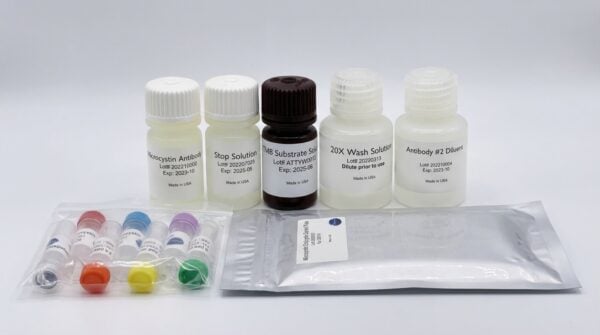
Each brevetoxin ELISA kit includes:
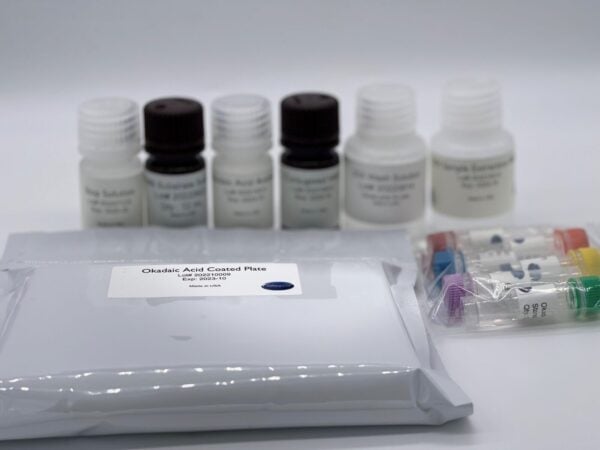
- 96-well microtiter plate coated with brevetoxin conjugate, in foil pouch
- Brevetoxin (PbTx-3) standards, 5 vials × 0.8 mL: 0, 0.2, 0.6, 1.2 and 6 ppb
- Brevetoxin Antibody #1, 11 mL
- 100X HRP-Conjugated Antibody #2, 0.25 mL, and Antibody #2 Diluent, 20 mL
- 20X Wash Solution, 28 mL
- TMB Substrate Solution, 12 mL
- Stop Solution, 14 mL
You will also need: an ELISA plate reader (450 nm/630 nm), deionized water, glass vials, methanol, 1X phosphate-buffered saline (PBS), a vortex mixer, a homogenizer, a timer, a wash bottle, 50 mL and 2 mL polystyrene centrifuge tubes, micropipettes covering 20–200 µL and 100–1000 µL, and a 300 µL multichannel pipette.
Volume discount: ordering 5 or more kits? Contact sales@attogene.com or call 512-333-1330 for a discount.
Who It’s For
The kit is designed for coastal monitoring programs, shellfish growers and processors, state and federal laboratories, and researchers studying red tide events and brevetoxin accumulation in shellfish.
How to Use the Brevetoxin ELISA Kit
Bring all reagents and microwells to room temperature (20–25 °C) for at least 30 minutes, and run standards and samples in duplicate. Brevetoxins are light sensitive, so keep standards and samples out of light.
- Prepare reagents: make 10% methanol/1X PBS from 1 volume of methanol and 9 volumes of PBS, and dilute the 20X Wash Solution 1:20 with deionized water.
- Prepare water samples: samples should be particle-free and at neutral pH. If needed, centrifuge at 3000 g for 5 minutes. Use 50 µL of supernatant.
- Prepare shellfish: shuck the shellfish, collect the viscera and homogenize for at least 3 minutes. Add 9.0 mL of 90% methanol/water to 1 g of homogenate, vortex 2 minutes and centrifuge 10 minutes at 3000 × g. Add 20 µL of supernatant to 980 µL of 10% methanol/1X PBS in a glass vial (dilution 1:50).
- First incubation: add 50 µL of standard or sample, then 100 µL of Antibody #1. Shake 30 seconds, cover and incubate 30 minutes at room temperature. Near the end of this step, freshly dilute the 100X HRP-Conjugated Antibody #2 1:100 in Antibody #2 Diluent.
- Wash: decant and rinse 3 times with 250 µL of 1X Wash Solution, then tap dry.
- Second incubation: add 150 µL of 1X HRP-Conjugated Antibody #2, shake, cover and incubate 30 minutes. Wash again.
- Develop, stop and read: add 100 µL of TMB Substrate Solution and incubate 15 minutes at 25 °C, covered. Add 100 µL of Stop Solution and read at 450 nm within 5 minutes.
Full instructions are in the EL2023-05 kit manual (PDF).
How It Works and Reading Results
Brevetoxins in the sample compete with brevetoxin conjugate on the plate for Antibody #1. More toxin means less bound antibody and a lighter blue color, and the result reflects total brevetoxin concentration.
Express each mean absorbance as a percentage of the zero standard (B/B0 × 100) and plot it against concentration on a semi-logarithmic scale. Read sample values from the curve and multiply by the dilution factor. If a sample is lighter than the 6 ppb standard, dilute it to fit the 0.2–6 ppb range and rerun.
Frequently Asked Questions
What is the detection limit of the brevetoxin ELISA kit?
The detection limit is 0.2 ppb in water, with a working range of 0.2 to 6 ppb. Shellfish extracts are diluted 1:50, so multiply results by that factor.
Which shellfish can I test?
The manual describes extraction of the viscera of mussels, clams, oysters and scallops using 90% methanol.
Why should samples be kept out of light?
Brevetoxins are light sensitive. The manual recommends keeping standards and samples out of light and avoiding direct sunlight during incubations.
What other shellfish toxin tests are available?
For paralytic shellfish poisoning toxins, see the Saxitoxin (PSP) ELISA Kit or the Saxitoxin (PSP) Rapid Test Kit for Shellfish. For diarrhetic shellfish poisoning toxins, see the Okadaic Acid (DSP) ELISA Kit.
How can I monitor blooms over time?
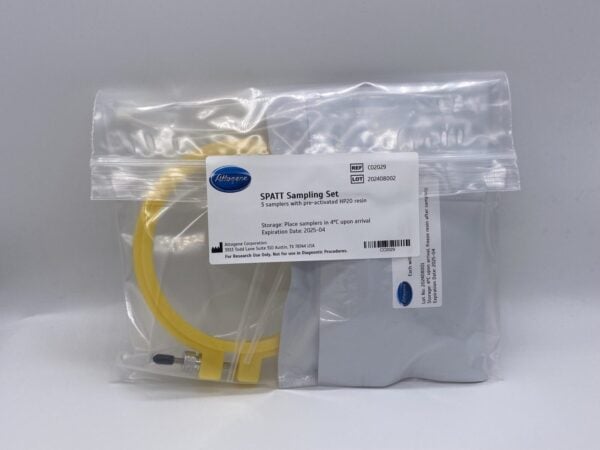
The SPATT Bag Set is available for passive bloom monitoring alongside the brevetoxin ELISA kit.
For research use only. Not for use in diagnostic procedures. Questions? Call 512-333-1330 or email sales@attogene.com.