
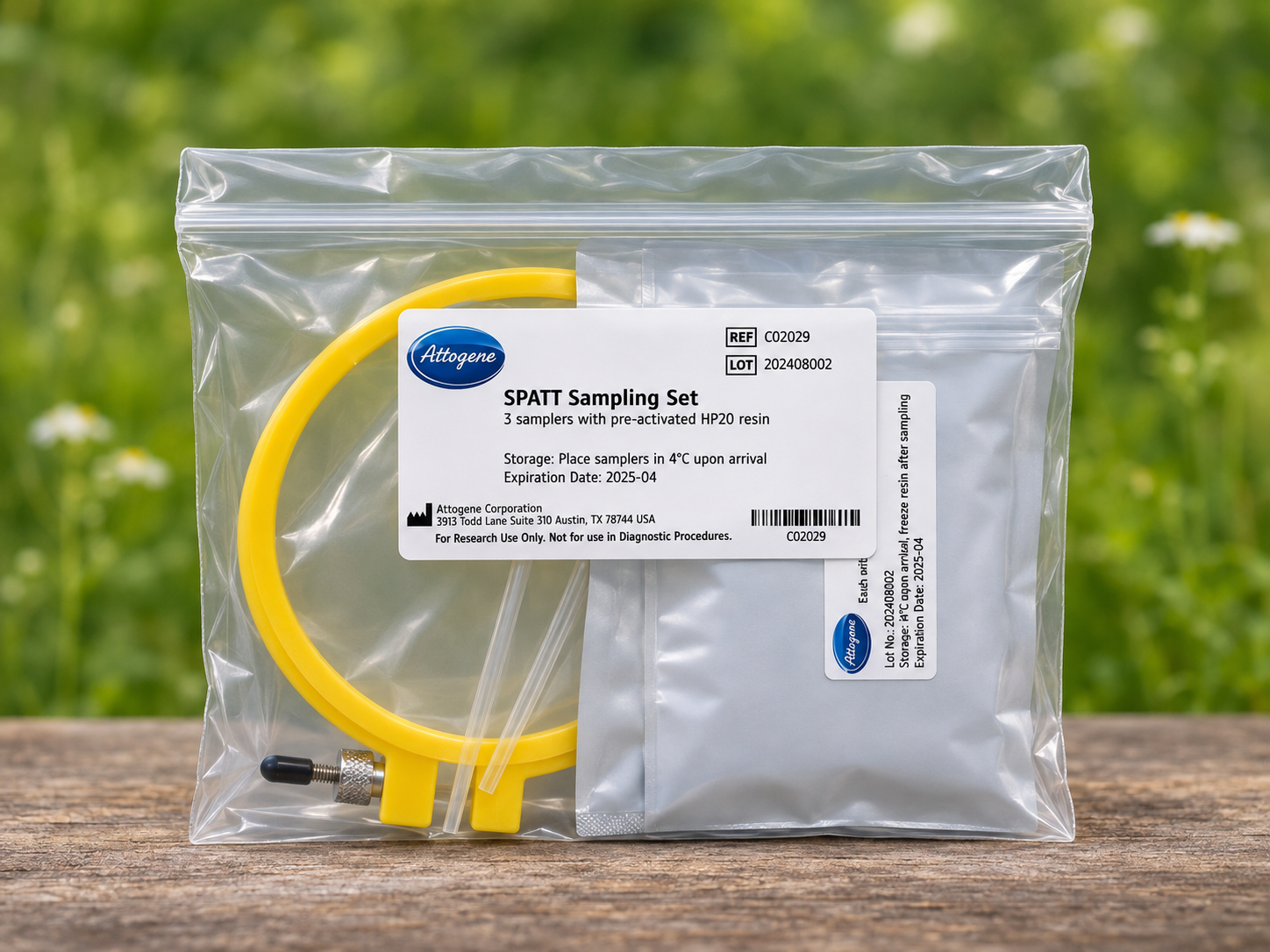


The Solid Phase Adsorption Toxin Tracking (SPATT) Bag Set (CO2029) is a SPATT bag set for passive, in-situ monitoring of harmful algal bloom (HAB) toxins in marine, brackish and fresh water. Each set contains three pre-activated SPATT bags, each holding 3 g of HP20 resin in 100 µm plankton mesh, plus a reusable 4-inch embroidery hoop, a zip tie and disposable scoopers. The bags arrive ready for deployment.
Unlike a grab sample, which captures one moment in time, a SPATT device adsorbs dissolved toxins over the whole deployment, typically 24 hours to 4 weeks. The result is a time-integrated picture that includes short-lived toxin events a single grab sample can miss.
Key Features
- Pre-activated HP20 resin: no methanol activation or wash steps before deployment. The bags ship in ultrapure water with 8% ethanol to keep the resin wet.
- Broad toxin capture: HP20 is widely applicable across cyanotoxins and marine biotoxins, from microcystins and cylindrospermopsin to saxitoxins, okadaic acid and brevetoxins.
- Time-averaged bioavailable fraction: SPATT uptake has been shown to resemble that of filter-feeding shellfish such as mussels and clams more closely than other sampling methods.
- Better sensitivity for low-level toxins: SPATT devices capture less common cyanotoxins, such as cylindrospermopsin, at lower concentrations than grab samples, and pick up microcystin-LR reliably.
What’s in the Set
Each SPATT bag set includes:
- SPATT bags: 3 bags, each with 3 g of HP20 resin in 100 µm plankton mesh. Store at 4 °C.
- Embroidery hoop: 1 reusable 4-inch hoop with a metal tension screw. Store at room temperature.
- Zip tie: 1, for attaching the device. Store at room temperature.
- Disposable scoopers: 3, for handling the resin for analysis. Store at room temperature.
You will also need: gloves, labeled ziplock bags, ice for transport, a freezer at -20 °C or colder, and for extraction a filter manifold, 20 mL disposable chromatography columns, 20 mL glass scintillation vials and the extraction solvents listed below.
Toxins Captured by HP20 Resin
The SPATT instructions list these toxin groups as captured by the HP20 resin:
- Cyanotoxins: microcystins (including MC-LR and MC-WR), cylindrospermopsin, anatoxin-a and nodularin
- Paralytic shellfish toxins: saxitoxin and derivatives (GNTXs, C-toxins)
- Diarrhetic shellfish toxins: okadaic acid and dinophysistoxins (DTXs)
- Brevetoxins from the red tide dinoflagellate Karenia brevis
- Domoic acid
- Yessotoxin and pectenotoxins
- Cyclic imines: spirolides, gymnodimines and pinnatoxins
- Ciguatera toxins: ciguatoxin, gambiertoxin and maitotoxin
Who It’s For
The SPATT bag set suits HAB monitoring programs, water quality managers, shellfish safety programs and research groups that need early warning of toxin-producing blooms. It is an affordable screening tool for lakes, reservoirs, estuaries and coastal sites, and a useful complement to grab sampling.
How to Use the SPATT Bag Set
- On receipt: refrigerate the bags immediately and do not freeze them before use. Keep the bags covered so the resin stays wet. If you move them to another container, keep the resin submerged in deionized water.
- Assemble: mount the SPATT bag in the embroidery hoop and tighten the tension screw.
- Deploy: attach the device with the zip tie to a pier, piling, floating platform, buoy or weighted line. Cages or canisters used for POCIS deployment also work. Choose a site at least 1 meter deep, and keep in mind that foot traffic and currents can move or remove the device.
- Sample: leave the device in place for the sampling period, typically 24 hours to 4 weeks.
- Retrieve: wearing gloves, rinse debris from the hoop and mesh with field water. Loosen the tension screw and remove the bag.
- Label and record: place each bag in a labeled ziplock bag, individually or grouped by site. Record the site name, deployment and retrieval dates and times, and observations.
- Freeze: put the bags on ice right away. If extraction will not start immediately, store them at -20 °C or colder as soon as possible. Freezing maximizes toxin recovery and makes the resin easier to handle.
- Extract: using the disposable scoopers, handle the resin for extraction with one of the solvent systems below, then analyze the extract with your chosen method.
See the full SPATT instructions (PDF) for details, references and resin specifications.
Extraction Solvents
The instructions give these solvent systems, based on 3 g of resin per bag:
- Domoic acid: 50% methanol in ultrapure (MQ) water, 10 mL; or 1 M ammonium acetate in 50% methanol, 10 mL or 20 mL
- All algal toxins: 100% methanol acidified with 2% formic acid, 10 mL; or 50% methanol in MQ water, 20 mL
Wear fresh gloves and proper PPE during all extraction steps, including any reactivation with 100% methanol or ethanol.
Measuring Toxins in SPATT Extracts
The SPATT instructions do not name a specific analysis method, so choose one that fits your toxins of interest and your lab. For screening, Attogene offers ELISA kits for several of the toxins the resin captures, including the Microcystin ELISA Kit, Saxitoxin (PSP) ELISA Kit, Okadaic Acid (DSP) ELISA Kit and Brevetoxin ELISA Kit. Check each kit manual’s sample requirements before running methanol extracts, since solvent content can affect immunoassays.
Keep in mind that SPATT measures only dissolved, extracellular toxins, not total or intracellular toxins. Water temperature, pH, flow velocity, turbulence and biofouling all affect the sampling rate. Without site calibration, SPATT works best as a screening tool rather than for standardized quantification.
Frequently Asked Questions
Do the SPATT bags need activation before deployment?
No. The HP20 resin in the SPATT bag set is pre-activated and ready to deploy. If the resin dries out before sampling, reactivate it with 100% methanol or ethanol.
How long should I deploy a SPATT bag?
Typical sampling periods range from 24 hours to 4 weeks, depending on bioactivity at the site.
How should I store the bags before use?
Refrigerate the SPATT bag set on arrival and do not freeze the bags before use. Keep the resin wet. For storage longer than a month, contact Attogene for recommendations.
What resin is in the bags?
Each bag in the SPATT bag set holds 3 g of Diaion HP20, a nonpolar, aromatic styrene-divinylbenzene adsorbent with a specific surface area of 90 m²/g and a pore volume of 1.3 mL/g.
Can I reuse the hoop?
Yes. The 4-inch embroidery hoop is reusable. The scoopers are disposable, and the resin in each bag is extracted after retrieval.
For research use only. Not for use in diagnostic procedures. Questions? Call 512-333-1330 or email sales@attogene.com.