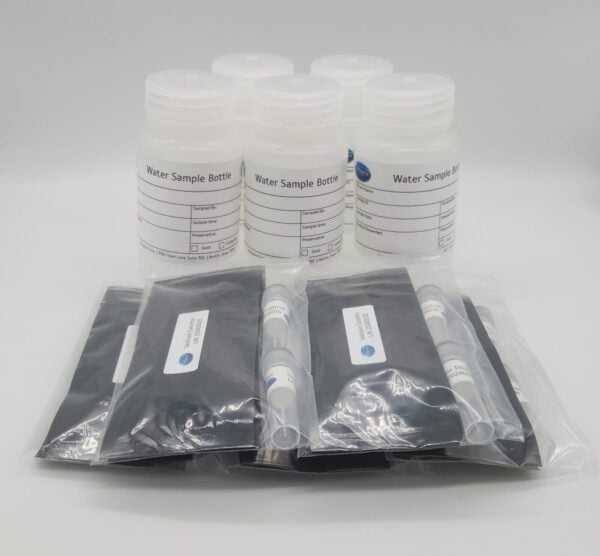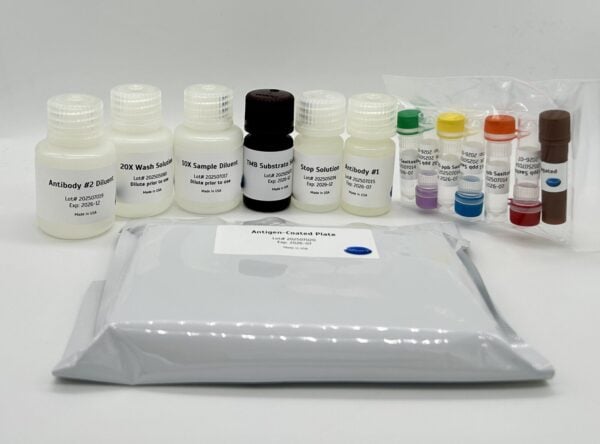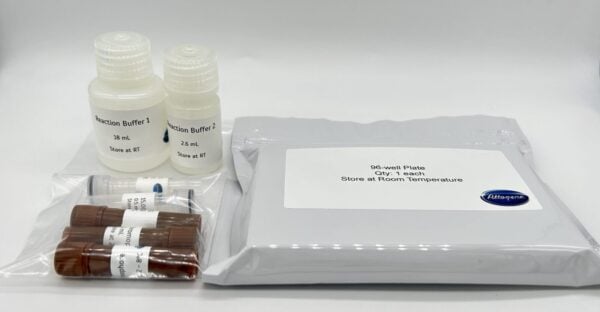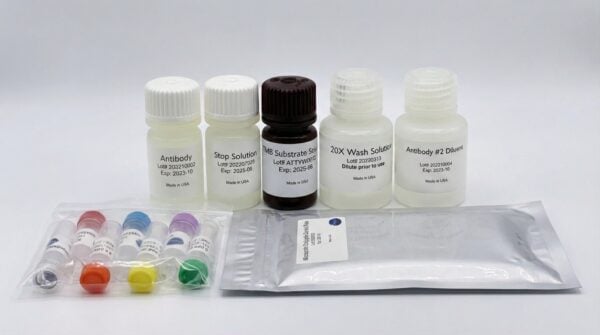


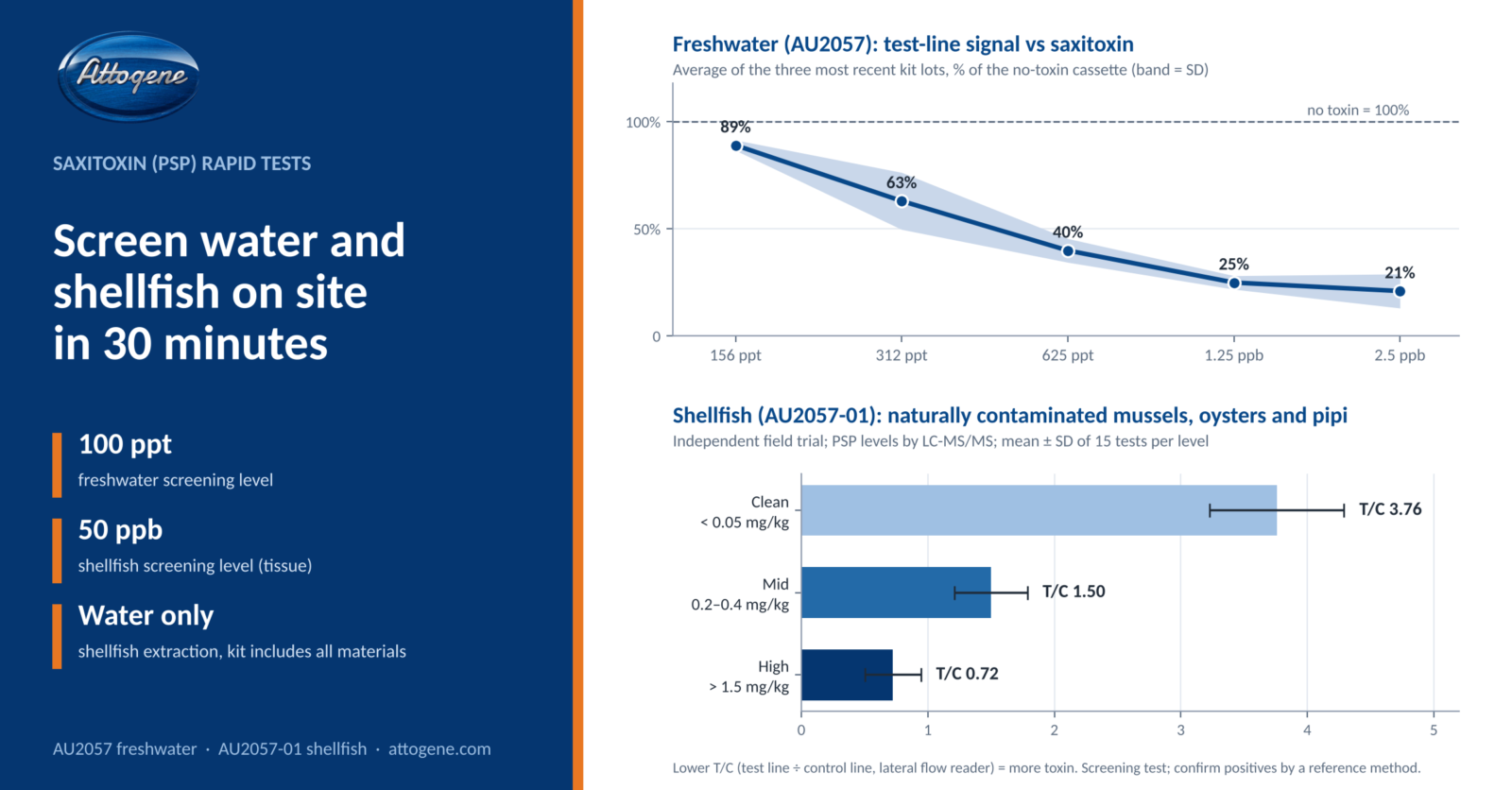


Attogene’s Saxitoxin (PSP) Rapid Test Kit for Shellfish is a lateral flow saxitoxin rapid test that screens shellfish tissue for paralytic shellfish poisoning (PSP) toxins. Each test screens at 50 ppb (50 µg/kg). When the test line is absent or only a trace, the sample is at about 800 ppb or above, the US FDA and EU regulatory limit. Results are ready in 30 minutes, and no pipettor or power is needed at the testing step.
Key Features
- Screening level: 50 ppb (µg/kg) saxitoxin in shellfish tissue
- Regulatory-limit indicator: no test line, or only a trace, means about 800 ppb or above
- Time to result: 30 minutes
- Simple extraction: 1 g of homogenized tissue in 30 mL of water, then a syringe filter. No solvents needed.
- Read by eye or by reader: compatible with the DETEKT lateral flow reader, with cut-offs that can be tailored to your requirements
- Room-temperature storage with an 18-month shelf life from the date of manufacture
- Format: 24 cassettes = 12 samples, each run with its own negative control
What’s in the Kit
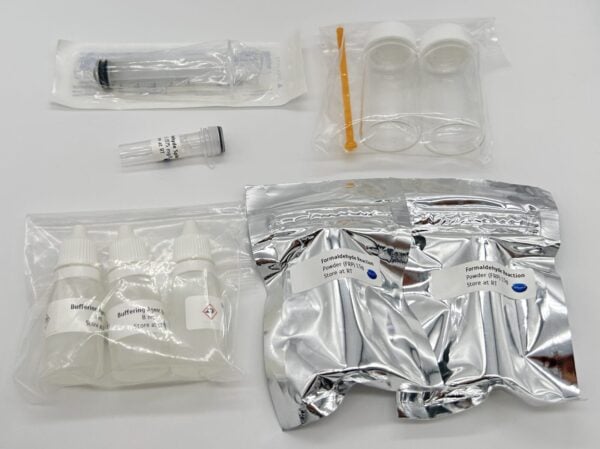
Each saxitoxin rapid test kit includes:
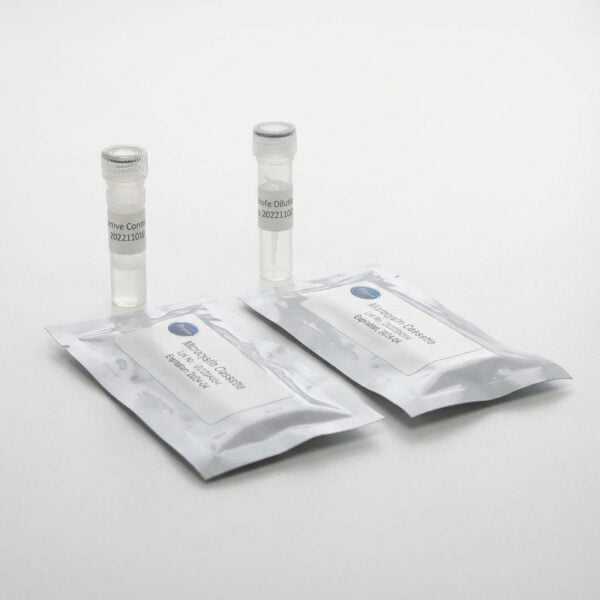
- 24 Saxitoxin cassettes, each in a foil pouch with desiccant
- 12 Sample Dilution Buffer tubes (10X, 30 µL)
- 12 Negative Control tubes (200 µL)
- 24 Fixed-volume pipettes (200 µL)
- 12 Syringes (1 mL) and 12 syringe filters (1.2 µm)
- 12 Conical tubes (50 mL) and 12 extract collection tubes
- Manual
You will also need: a high-speed blender, a balance (0.5–100 g), distilled or deionized water (30 mL per sample), a timer, gloves and a marker. Extra Sample Dilution Buffer (PN2194-2) is available in 12- or 24-packs. Note that buffers for the shellfish and freshwater kits are not interchangeable.
Who It’s For
- Shellfish growers and harvesters checking product before harvest or sale
- State and tribal shellfish sanitation and harvest-area monitoring programs
- Seafood processors and QA labs that need a fast first-pass PSP screen
- Researchers studying harmful algal blooms and toxin uptake in bivalves
How to Use the Saxitoxin Rapid Test
- Homogenize: shuck and rinse the shellfish meat, then blend it for at least 2 minutes.
- Extract: weigh 1 g of homogenate into a 50 mL conical tube, add 30 mL of water and shake until suspended.
- Filter: draw the extract into the syringe, attach the 1.2 µm filter and filter it into an extract collection tube.
- Run the negative control: add 200 µL of negative control to cassette A and start the timer.
- Run the sample: add 200 µL of filtered extract to a dilution buffer tube, mix, then add 200 µL to cassette B.
- Read both cassettes at 30 minutes, side by side.
Full instructions are in the AU2057-01 product manual (PDF).
Reading Your Results
This is a competitive test, so a weaker test line means more saxitoxin. Always compare the sample cassette with its negative control.
- Sample test line as strong as the negative control’s: below 50 ppb
- Sample test line lighter than the negative control’s: 50 ppb or above
- No test line, or only a trace: about 800 ppb or above (regulatory limit)
A control line must appear for a valid result. The control line gets stronger as saxitoxin increases. For numerical readouts and custom cut-offs, use the DETEKT lateral flow reader.
How the Test Works
The saxitoxin rapid test is a competitive immunoassay. As the sample flows along the strip, it picks up colloidal gold coated with an anti-saxitoxin monoclonal antibody. The test line carries a saxitoxin–BSA conjugate. With no saxitoxin present, the gold binds the test line and a strong red line forms. Saxitoxin in the sample blocks the antibody, so less gold binds the test line and more is captured at the control line.
Cross-Reactivity and Confirmation
The kit responds most strongly to saxitoxin (STX). It responds moderately to gonyautoxins GTX2/3, weakly to GTX1/4, and little or not at all to neosaxitoxin (neoSTX), GTX5 and GTX6. A result below 800 ppb therefore does not rule out total PSP toxicity above the limit. Confirm positive screens, and any result used for a regulatory decision, by ELISA, HPLC, LC-MS/MS or another conventional method.
About Saxitoxin and PSP
Saxitoxins (STXs) are naturally occurring alkaloids produced by some marine dinoflagellates and by strains of several freshwater cyanobacteria. Saxitoxin is one of the most prevalent paralytic shellfish toxins. It is a potent neurotoxin with a molecular weight of about 300 Da, built on a tetrahydropurine ring system with a highly polar guanidinium group. During harmful algal blooms, saxitoxins accumulate in filter-feeding shellfish such as mussels, clams, oysters and scallops, and they can cause paralytic shellfish poisoning in people who eat them. The regulatory limit used by the US FDA and the EU is 800 µg saxitoxin-dihydrochloride equivalents per kg of shellfish meat (80 µg per 100 g).
Frequently Asked Questions
How long does the saxitoxin rapid test take?
The cassettes are read at 30 minutes. Extraction and filtering add a few minutes per sample.
What detection level does the kit screen at?
50 ppb (50 µg/kg) in shellfish tissue. An absent or trace test line indicates about 800 ppb or more, the regulatory limit.
Does it detect all PSP toxins?
No. It is most sensitive to saxitoxin and has partial or no response to some analogs, including neoSTX, GTX5 and GTX6. Use it as a screen, and confirm results with a conventional method.
Can I use it for water samples?
This kit is validated for shellfish tissue. For water, use the Saxitoxin Rapid Test Kit for Freshwater.
Do I need a lab to run it?
No full lab is needed, but you do need a blender, a balance and distilled or deionized water for the extraction. The testing step itself needs no pipettor or power.
How should I store the kit and samples?
Store the saxitoxin rapid test kit at room temperature, with cassettes sealed in their pouches until use. Live shellfish can be held at 4 °C for up to 2 days. Homogenize or freeze tissue right after shucking.
What other shellfish and saxitoxin tests do you offer?
For quantitative results, see the Saxitoxin (PSP) ELISA Kit. For toxin-gene detection, see the Saxitoxin qPCR Detection Kit (sxtA). For neurotoxic shellfish poisoning, see the Brevetoxin ELISA Kit.
For research use only. Not for use in diagnostic procedures. Questions, bulk cassettes or custom formats? Call 512-333-1330 or email sales@attogene.com.