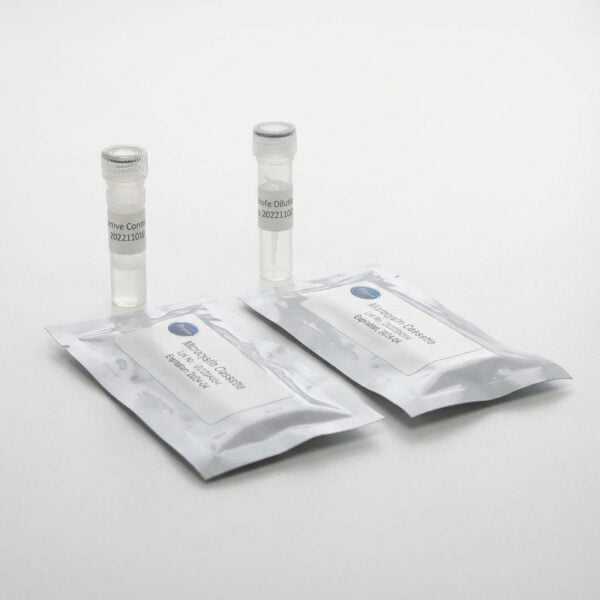



Attogene’s Microcystin Detection Kit (Rapid – Finished Drinking Water) is a microcystin drinking water test that screens treated water for microcystins at 0.1 ppb (µg/L), well below health guideline levels. Results are ready in 15 minutes and can be read by eye or, for the most confidence, with a lateral flow reader.
Key Features
- Screening level: 0.1 ppb microcystins. A missing test line indicates ≥ 5 ppb.
- Semi-quantitative range: 0.1–5 ppb when run alongside standards
- Run time: 15 minutes
- Below guideline levels: screens under the WHO provisional limit (1.0 ppb microcystin-LR) and the EPA health advisories (0.3 ppb for young children, 1.6 ppb for everyone else)
- Reader compatible: a lateral flow reader is recommended for low-level results
- Room-temperature storage: 2–30 °C
- Format: 10 cassettes = 5 sample tests + 5 negative controls
What’s in the Kit
Each microcystin drinking water test kit includes:
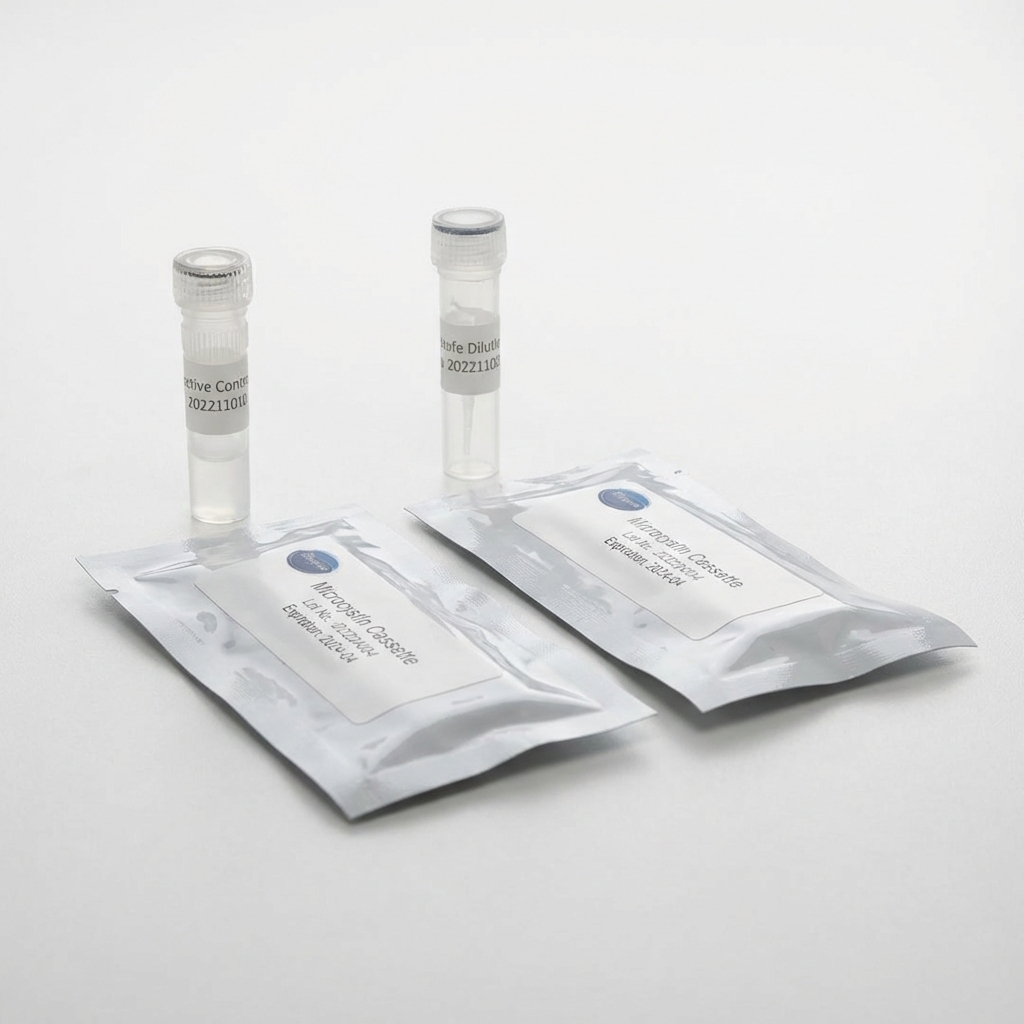
- 10 Microcystin lateral flow cassettes (individually foil-pouched with desiccant)
- 10 Transfer pipettes
- 5 Sample dilution buffer tubes (20 µL each)
- 5 Negative control tubes (200 µL each)
- Manual
You will also need: sample bottles, a 200 µL pipettor and tips, a centrifuge for turbid samples, and a timer. Extra Sample Dilution Buffer is available as an add-on (5 or 10 pack) above.
Who It’s For
- Drinking water utilities monitoring treated water during a bloom in the source water
- Small and rural water systems that need a fast in-house screen
- Environmental and contract labs screening samples before confirmatory analysis
- Public health researchers studying cyanotoxin removal
How to Use the Microcystin Drinking Water Test
- Prepare: bring cassettes, buffer and samples to room temperature. Quick-spin each buffer tube so the buffer sits at the bottom.
- Sample: add 200 µL of sample to a buffer tube, mix 3 times, then add the buffered sample to a cassette.
- Negative control: add 200 µL of negative control to a second cassette.
- Read both cassettes at 15 minutes, by eye or with a reader.
Full instructions are in the AU2024-02 manual (PDF).
Reading Your Results
This is a competitive test, so a weaker test line means more microcystin. Compare each sample to its negative control.
- Test line as dark as or darker than the control’s: below the detection limit
- Test line lighter than the control’s: ≥ 0.1 ppb
- No test line (control line only): ≥ 5 ppb
In reader testing, the test-to-control line ratio dropped from 0.92 at 0 ppb to 0.69 at 0.1 ppb, 0.50 at 1 ppb and 0.09 at 5 ppb. Confirm positives by ELISA, such as Attogene’s Congener-Independent Microcystin/Nodularins ELISA Kit, or by HPLC or LC-MS/MS.
Why Test Drinking Water for Microcystins?
Microcystins are liver toxins produced by cyanobacteria during harmful algal blooms, and they are the most frequently reported cyanotoxins. When a bloom forms in a lake or reservoir used as a drinking water source, toxins can reach the treatment plant. Fast screening of finished water helps operators confirm that treatment is working and decide when to send samples for confirmatory analysis.
Frequently Asked Questions
How sensitive is the microcystin drinking water test?
It screens at 0.1 ppb, below the EPA’s 0.3 ppb health advisory for young children.
How long does it take?
15 minutes per run.
Can I use it for lake or recreational water?
For untreated lake water, use the Microcystin Test Kit (Rapid – Recreational Water) or the Microcystin Detection Kit (Rapid – Lab).
Do I need a reader?
No, results can be read by eye. A lateral flow reader is recommended for the most reliable low-level results.
How should I store samples and the kit?
Refrigerate samples for up to 5 days, or freeze them for longer storage. Store the microcystin drinking water test kit at 2–30 °C.
Not sure which test you need? Read our guide: Microcystin ELISA vs. Rapid Test Strips vs. qPCR: How to Choose a Microcystin Test.
For research use only. Not for use in diagnostic procedures. Questions? Call 512-333-1330 or email sales@attogene.com.