

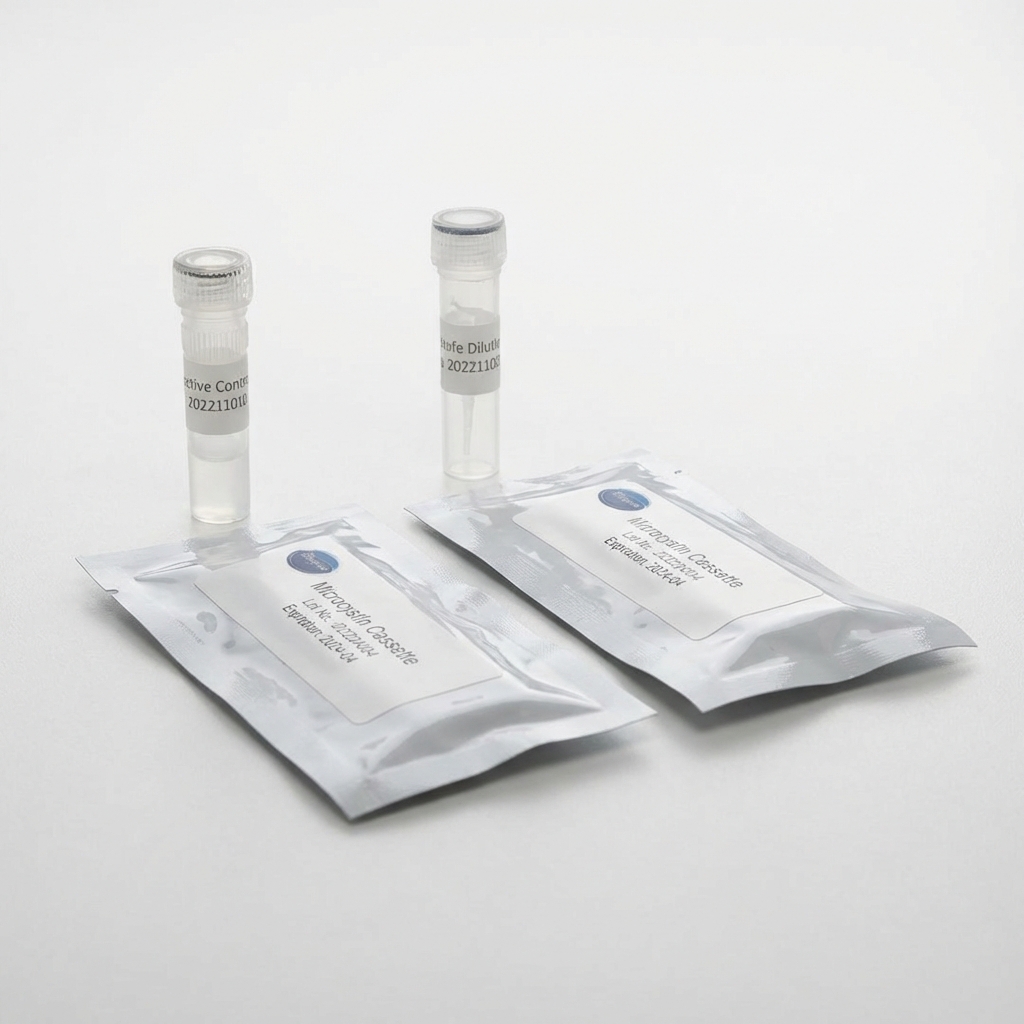


Attogene’s Microcystin Test Kit (Rapid Lab) can be used to detect microcystins in liquid samples.
- Format: 10 tests
- Run Time: 10 Minutes
The most frequently reported cyanobacterial toxins are the hepatotoxic microcystins (MCs). MCs are peptides with a molecular weight ranging from 900 to 1,100 Da. They consist of seven amino acids of which the two terminal amino acids of the linear peptide are condensed to form a cyclic compound.
A tiered notification system which takes different actions based on different numeric thresholds for microcytin-LR concentrations in recreational waters has been developed. This is guidance that allows states to take various actions?such as posting information about harmful algal blooms (HABs), issuing a recreational public health advisory, or temporarily closing recreational waters through a no contact advisory?depending on the severity of the bloom event.
Tier I – Caution Advisory: A caution advisory should be issued based on visual reports of a bloom, reports of animal or human illness, or water samples with density or concentrations of cyanotoxins below “warning advisory” levels. People should use caution when in contact with the body of water and avoid areas of algae accumulation. Caution signs should be posted at all primary public access locations and include the following information:
• Cyanotoxins may be present, and the water may be unsafe for people and animals.
• Discourage people from having contact with the water with visible algal blooms.
• Keep pets away from either drinking or swimming in affected water. Pets should not lick the algae off their fur or eat dried algae. Pets should be rinsed off with clean water.
• If fish are caught where HABs may be present, all internal organs should be removed prior to consumption and fillets rinsed with clean water.
• Contact information for the posting authority.
• Date of the posting.
• What to do in case of contact with the water.
• Who to call in case of both human and animal illness related to potential
Tier II – Warning Advisory
A warning advisory should be issued if one or more of the following conditions are true (Table 3):
• Cyanobacteria cell density is greater than or equal to 20,000 cells/mL.
• Microcystin concentrations are greater than or equal to 8 μg/L.
• Cylindrospermopsin concentrations are greater than or equal to 15 μg/L.
• Anatoxin-a is detected.
It is recommended that actions be taken over and above those listed for the Tier I – Caution Advisory. Signs should include the following information:
• Cyanotoxins are present, and the water is unsafe for people and animals.
• Restrict swimming, water skiing, boating and other activities that would involve direct, incidental, or accidental contact with the affected water.
• Warn owners not to allow pets to drink or swim in the water. Pets should not lick the algae off their fur or eat dried algae. Pets should be rinsed off with clean water.
• If fish are caught where HABs may be present, all internal organs should be removed prior to consumption and fillets rinsed with clean water.
• Contact information for the posting authority.
• Date of the posting.
• What to do in case of contact with the water.
• Who to call in case of both human and animal illness related to potential exposure.
Tier III – Danger Advisory
A danger advisory should be issued when there is confirmation of the presence of HABs through laboratory testing and if one or more of the following conditions are true:
• Cyanobacterial cell density is greater than or equal to 100,000 cells/ml.
• Microcystin concentrations are greater than or equal to 20 μg/L.
• Cylindrospermopsin concentrations are greater than or equal to 17 μg/L.
• Anatoxin-a concentrations are greater than or equal to 60 μg/L.
It is recommended that actions be taken over and above those listed for the Tier I – Caution Advisory and Tier II – Warning Advisory. Signs should include the following information:
• Cyanotoxins are present, and the water is unsafe for people and animals.
• Any recreational activity should not be allowed (such as swimming, water skiing, boating, and fishing).
• Water body should be closed.
Guide for Public Health Response to Cyanobacterial Harmful Blooms in Recreational Fresh Water
• Contact information for the posting authority.
• Date of the posting.
• What to do in case of contact with the water.
• Who to call in case of both human and animal illness related to potential exposure.
Microcystin-LR Ohio Standard:
Informational sign postings about HABs at recreational waters: < 6 g/L
Recreational public health advisory: 6 g/L
Elevated recreational public health advisory (e.g. no contact): 20 g/L
Inquire for bulk discounts at sales @attogene.com


