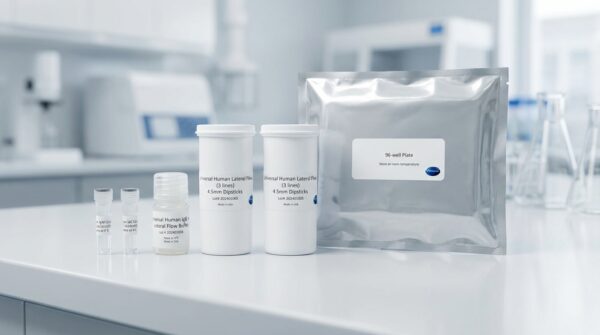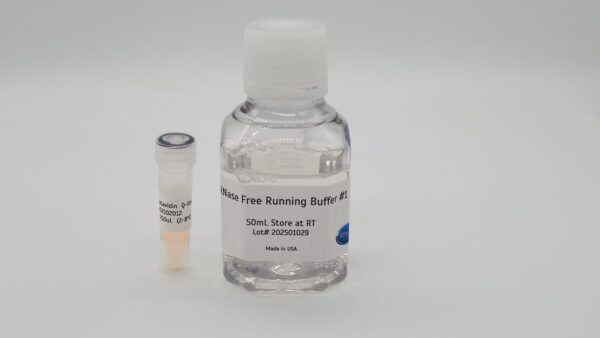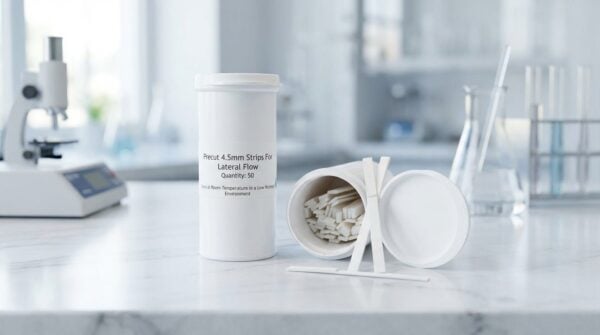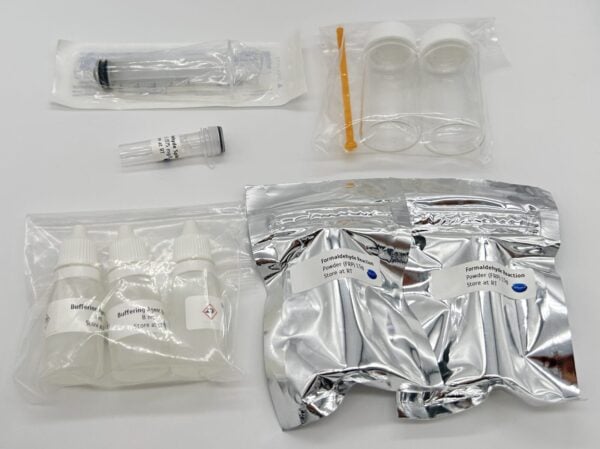


The Protein Biotinylation Kit (CO2028) is a protein biotinylation kit for labeling antibodies and other proteins with biotin for lateral flow and other streptavidin-based assays. It uses NHS-PEG4-Biotin, an amine-reactive NHS ester with a PEG spacer arm, and includes micro spin desalting columns for buffer exchange before labeling and cleanup afterward. Each reaction labels 50 to 200 µg of protein in a 100 µL sample volume, with a 30-minute incubation at room temperature.
The kit is made by Attogene in the USA and is designed to pair with Attogene streptavidin conjugates and Universal Lateral Flow Kits.
Key Features
- NHS-PEG4-Biotin chemistry: the NHS ester reacts with primary amines on the protein, and the PEG4 spacer arm keeps the biotin accessible to streptavidin.
- Pre-weighed biotin: 0.5 mg tubes reconstitute in 100 µL of 1X PBS to give an 8.5 mM working solution, so there is no weighing step.
- Built-in cleanup: micro spin desalting columns remove interfering buffer components before labeling and unreacted biotin after.
- Fast protocol: a 30-minute labeling step at room temperature, with short spins at 1,500 rcf for buffer exchange.
- Lateral flow ready: designed for use with Attogene streptavidin colloidal gold, streptavidin quantum dots and Universal Lateral Flow Kits.
What’s in the Kit
Each protein biotinylation kit includes:
- Micro Spin Desalting Columns: 16 columns, 0.5 mL. Store at 2–8 °C.
- NHS-PEG4-Biotin: 8 tubes, 0.5 mg each. Store at 2–8 °C with desiccant.
- 20X PBS: 15 mL. Store at 2–8 °C. Dilutes to 1X PBS (10 mM sodium phosphate, 0.15 M NaCl, pH 7.5).
- Instruction booklet: 1.
Each labeling uses one biotin tube and two desalting columns, one for buffer exchange and one for cleanup, so the kit covers eight labeling reactions.
You will also need: 1.5 mL or 2.0 mL microcentrifuge tubes, a variable-speed microcentrifuge, P-10, P-200 and P-1000 pipettes, and ultrapure water. Extra columns for buffer exchange are available as G-25 Micro Spin Desalting Columns.
Who It’s For
The protein biotinylation kit is for lateral flow and immunoassay developers who need a biotinylated antibody or protein as a capture or detection reagent. It suits teams building a first prototype with the Universal Lateral Flow Assay Kit and labs that label several antibodies in small amounts for screening.
How to Use the Protein Biotinylation Kit
- Prepare buffer: dilute the 20X PBS to 1X with ultrapure water.
- Prepare a column: snap off the bottom tab, loosen the cap, place the column in a 1.5 or 2 mL tube and spin for 1 minute at 1,500 rcf. Add 300 µL of azide-free buffer and spin for 1 minute at 1,500 rcf; repeat for three washes in total. Mark the column so the slanted resin faces outward in every later spin.
- Exchange the protein buffer: move the washed column to a clean tube, apply 30 to 100 µL of antibody to the resin bed (add a 15 µL stacker after absorption if the sample is under 70 µL), and spin for 2 minutes at 1,500 rcf. Collect the flow-through.
- Reconstitute the biotin: add 100 µL of 1X PBS to one NHS-PEG4-Biotin tube and pipette to dissolve. Prepare it fresh, and return unused tubes to 4 °C with desiccant.
- Label: add the calculated volume of 8.5 mM biotin to the protein, mix gently and incubate at room temperature for 30 minutes.
- Remove free biotin: load the reaction onto a second washed column in a new tube and spin for 2 minutes at 1,500 rcf. The flow-through is your biotinylated protein.
- Store: keep the labeled protein at 4 °C for less than one month, or at -20 °C or -80 °C for longer. A preservative such as sodium azide may be added after labeling.
Download the CO2028 instruction booklet (PDF) for the full protocol and calculations.
Calculating the Biotin Volume
The booklet recommends a 40-fold molar excess of biotin over protein. Work out the moles of protein from its mass and molecular weight (150,000 for IgG), multiply by 40, then convert to a volume of the 8.5 mM NHS-PEG4-Biotin solution (molecular weight 589). As a worked example, 100 µg of IgG is about 0.67 nmol, so a 40-fold excess is about 27 nmol of biotin, or roughly 3.1 µL of the 8.5 mM solution.
Buffer Requirements
- Use: 1X PBS from the kit, PBS without preservative, HEPES or another sodium azide-free buffer.
- Avoid during labeling: buffers that contain primary amines, carrier proteins such as BSA or gelatin, and sodium azide. Amines compete with the protein for the NHS ester. The buffer-exchange step removes small molecules such as azide and amine buffers, but not carrier proteins like BSA.
Using Biotinylated Proteins in Your Assay
Biotinylated antibodies bind tightly to streptavidin, which makes them easy to pair with Attogene detection reagents. Use them with Streptavidin Colloidal Gold (AU2017) for a visual lateral flow signal, Streptavidin Quantum Dots (AU2043) for a fluorescent signal, or the Universal Lateral Flow Kits (AU2034, AU2037 or AU2044). Biotinylated proteins can also be captured on Streptavidin Coated ELISA Plates.
Frequently Asked Questions
How much protein can I label with the protein biotinylation kit?
Each reaction labels 50 to 200 µg of protein in a 100 µL sample volume. The desalting columns accept 30 to 100 µL.
Can I label an antibody that contains BSA or sodium azide?
Sodium azide and amine-containing buffers can be removed by running the sample through the first desalting column into azide-free PBS. Carrier proteins such as BSA or gelatin should not be present during labeling, and the desalting column does not remove them, so start with a carrier-free antibody.
How many labelings does the kit support?
The protein biotinylation kit contains 16 desalting columns along with 8 biotin tubes. Each labeling uses one tube and two columns, so the kit covers eight reactions.
Can I store the reconstituted biotin?
No. Prepare the 8.5 mM biotin solution fresh before each use and discard any leftover. Keep unopened tubes at 2–8 °C with desiccant.
For research use only. Not for use in diagnostic procedures. Questions? Call 512-333-1330 or email sales@attogene.com.