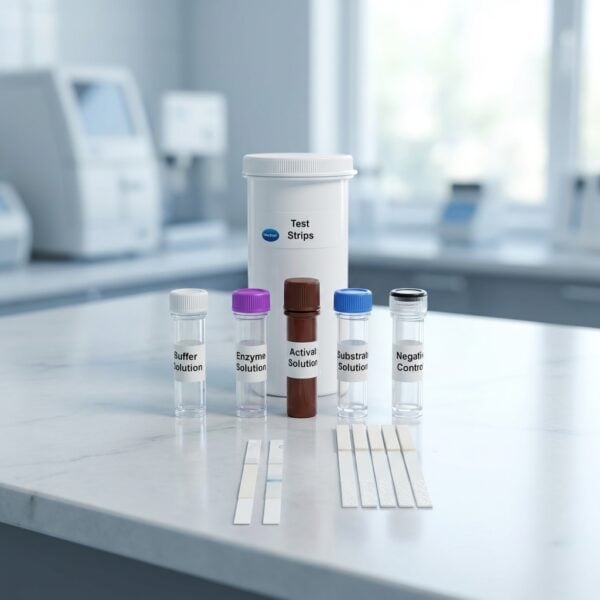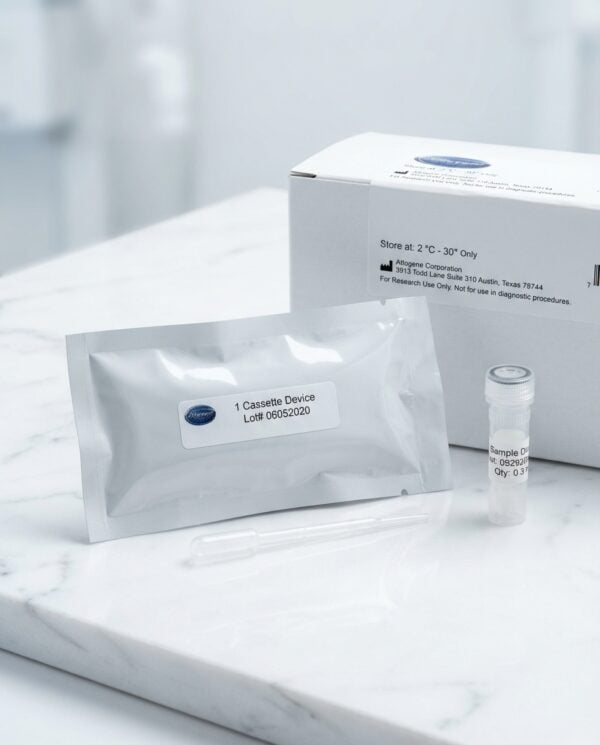




The Attogene Caffeine Rapid Detection Kit – Field Use (AU2067-01) is a caffeine test kit for screening drinks on site in 15 minutes, with no pipettor or power needed. Each drink is diluted 1:400 in a bottle of Sample Dilution Buffer using a fixed-volume pipette, then tested on a single-use lateral flow cassette. The cutoff is 10 ppb caffeine in the diluted drink, which corresponds to about 4 ppm (4,000 ppb) in the original drink. Each kit contains 10 cassettes for 5 samples, each read against its own negative control.
Key Features
- Field-ready: fixed-volume pipettes and pre-filled buffer bottles; no pipettor, power or laboratory needed.
- 15-minute result: read at 15 minutes, and no later than 20 minutes, by eye or with a lateral flow reader.
- About 4 ppm cutoff in the drink: caffeinated drinks give a strong positive, and most decaffeinated coffees read low positive.
- Paired negative control: every sample is read side by side with its own negative control cassette.
- Room-temperature storage: all components are stored at room temperature.
What’s in the Caffeine Test Kit
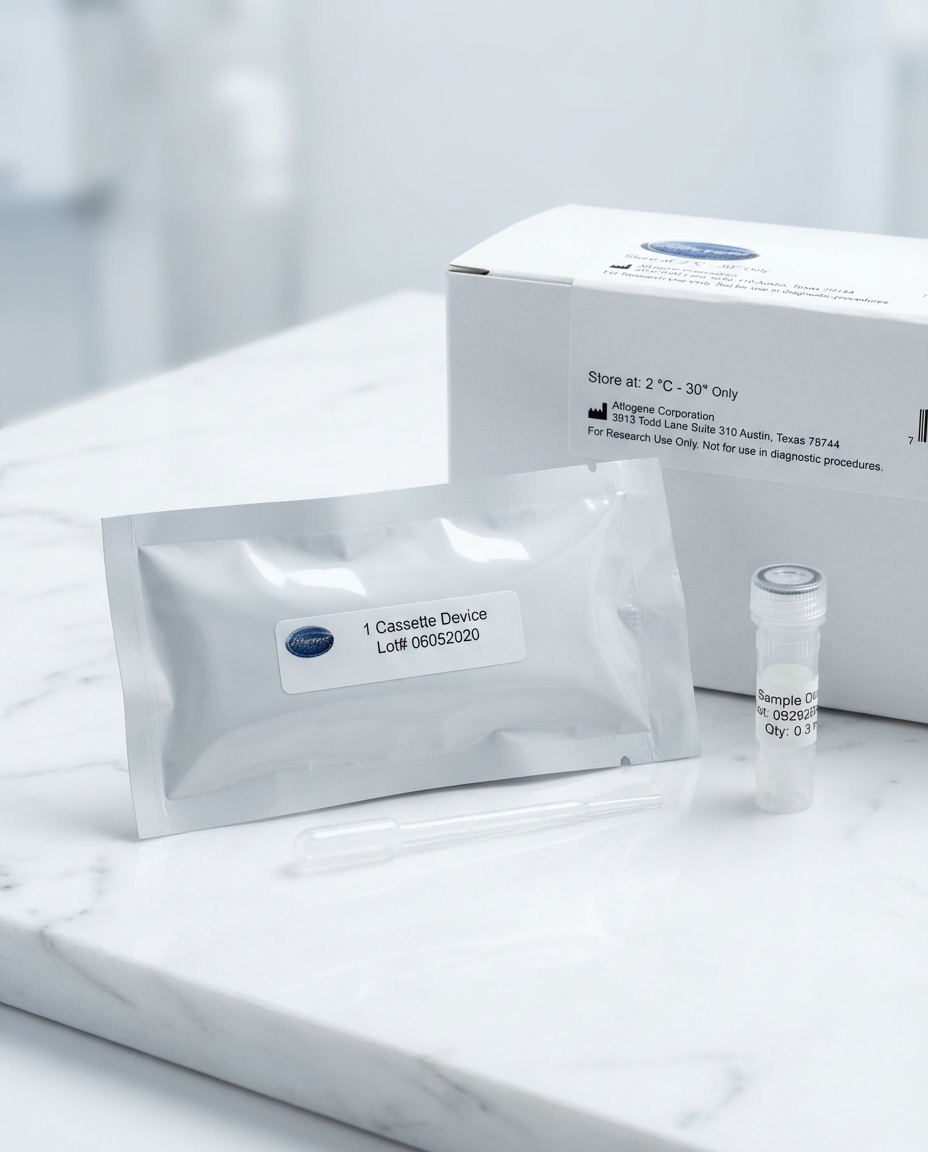
Each caffeine test kit includes:
- 10 caffeine cassettes, each in a foil pouch with desiccant
- 10 bottles of Sample Dilution Buffer, 30 mL each (also used as the negative control)
- 10X Running Buffer concentrate, 5 mL, for extra dilutions
- 10 fixed-volume pipettes, 75 µL (for the drink)
- 10 fixed-volume pipettes, 200 µL (to the cassette)
- Manual
You will also need: a timer, a permanent marker, and a clean cup or glass to hold each drink. For optional extra dilutions you will also need clean bottled or distilled water and a clean tube.
Who It’s For
- Food service, hospitality and beverage teams checking whether a drink contains caffeine
- Quality and product-development staff verifying decaffeinated or caffeine-free products
- Researchers and educators who need a simple on-site caffeine screen
- Anyone testing drinks away from a laboratory
How to Use the Caffeine Test Kit
- Bring cassettes, buffer and drinks to room temperature. Let hot drinks cool and stir carbonated drinks until they stop fizzing.
- Lay two cassettes flat for each drink and label them, for example “NC” and the drink name.
- Negative control: open a Sample Dilution Buffer bottle. With a new 200 µL pipette, draw buffer to the fill mark and dispense it into the sample port of the NC cassette. Start the timer.
- Sample: with the 75 µL pipette, add the drink to the same bottle. Cap tightly and invert 10 times to mix.
- With a new 200 µL pipette, add the diluted drink to the sample port of the sample cassette, all at once.
- Leave both cassettes flat and undisturbed, and read them side by side at 15 minutes.
To check whether a positive drink is far above the cutoff, make 1X buffer from the 10X Running Buffer concentrate (1 part plus 9 parts water), dilute the drink 1:10 in it, and test again; the cutoff then corresponds to about 40 ppm in the drink. See the AU2067-01 instruction manual (PDF) for full details.
Reading Results
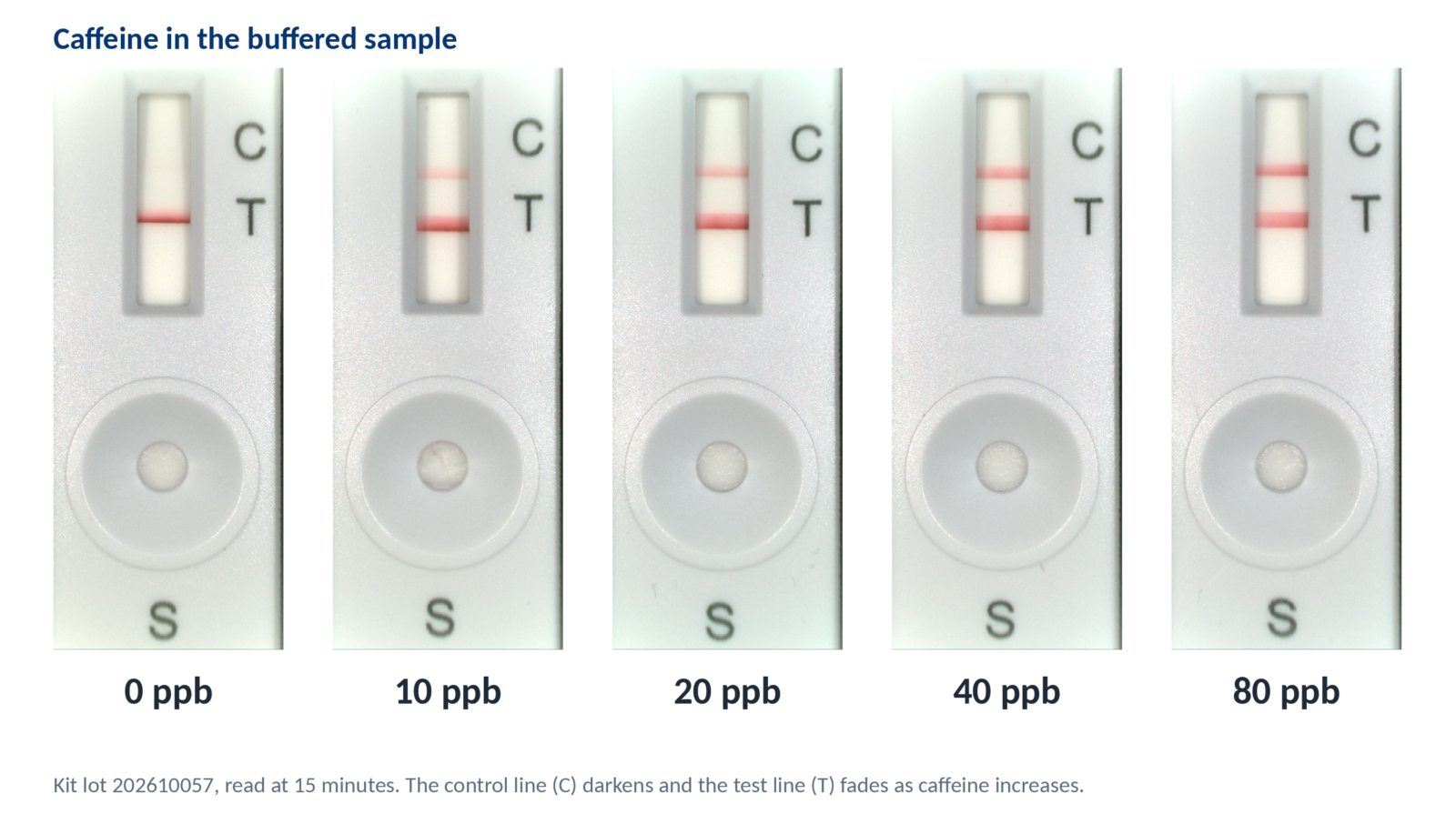
The test is a competitive immunoassay. Gold-labeled anti-caffeine antibody binds a caffeine-BSA test line (T) when no caffeine is present. Caffeine in the drink blocks the antibody, so the test line gets weaker and the control line (C) gets darker. A faint or missing C line is normal for a caffeine-free drink in this kit.
- Negative: looks like the negative control; strong T line, C line faint or absent. Below about 4 ppm in the drink, for example a caffeine-free drink.
- Low positive: T still darker than C, but C clearly darker than on the negative control. About 4 to 40 ppm in the drink, for example most decaffeinated coffees.
- Positive: C as dark as or darker than T, or no T line. About 40 ppm or more, typical of a caffeinated drink.
- Invalid: no line on a cassette, or no strong T line on the negative control.
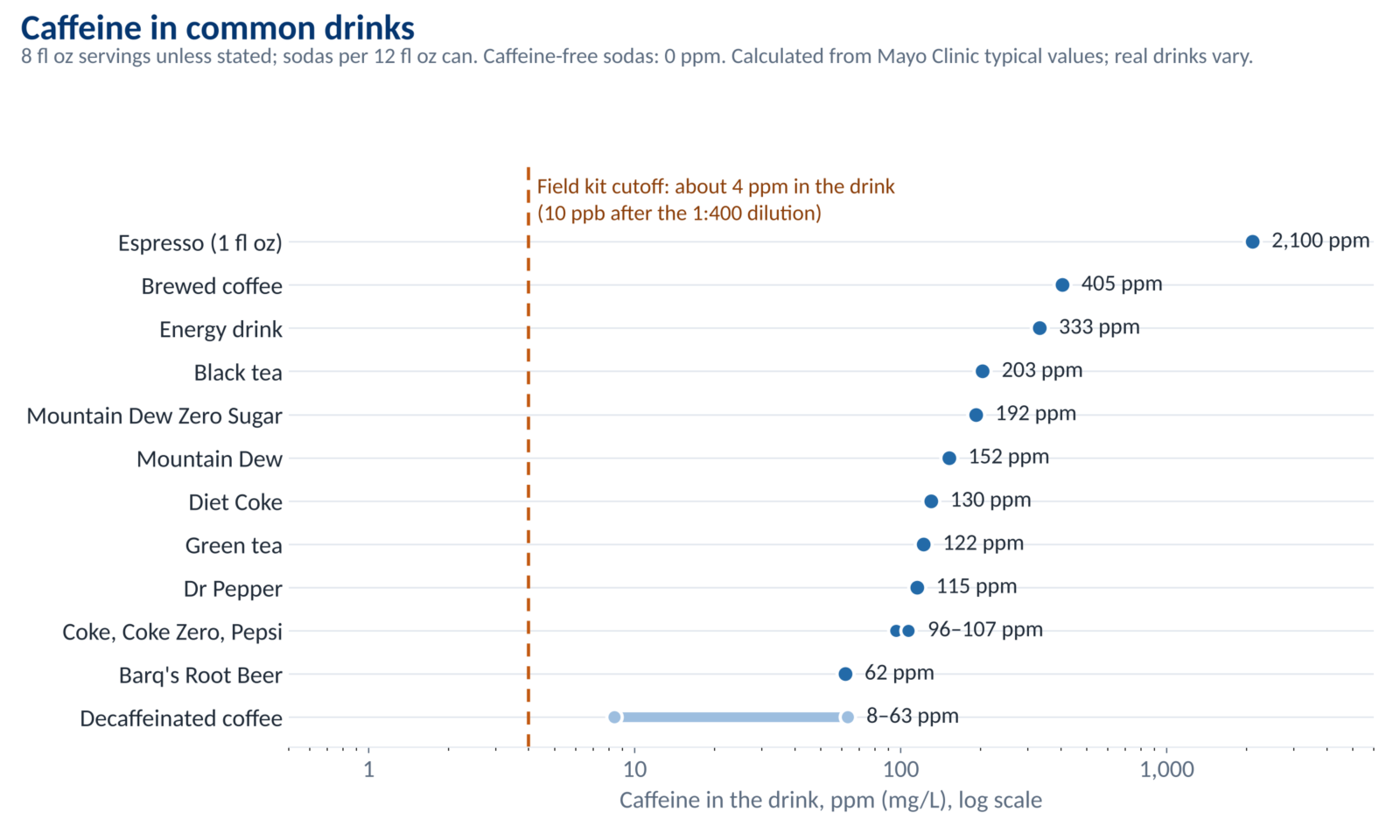
For reference, brewed coffee contains about 400 ppm caffeine, cola about 140 ppm and brewed green tea about 120 ppm, while most citrus sodas and root beers contain none.
Frequently Asked Questions
Do I need lab equipment to run the caffeine test kit?
No. The kit includes fixed-volume pipettes and pre-filled buffer bottles, so you need only a timer, a marker and a cup for the drink.
Will decaffeinated coffee test positive?
Usually as a low positive. Brewed decaf typically contains 2–15 mg per 8 oz cup, which is above the roughly 4 ppm cutoff in the drink.
Which drinks give the most reliable results?
Black coffee, tea and clear soft drinks. Drinks with milk, cream, syrups or pulp have not been evaluated.
Does the caffeine test kit give an exact concentration?
No. It is a screening test. To estimate concentration, run caffeine standards of known concentration (not supplied) alongside the samples. Confirm results used for any decision by HPLC, LC-MS/MS or another conventional method.
Can I test urine or water with this kit?
This version is made for drinks. For urine and water, use the laboratory version, the Caffeine Rapid Detection Kit (Urine Compatible, AU2067), which accepts 1–20 µL of sample. For nicotine, see the Nicotine Rapid Detection Kit (AU2068).
For research use only. Not for use in diagnostic procedures. Questions? Call 512-333-1330 or email sales@attogene.com.