



The Attogene Pesticide Detection Strip Test (AU2070) is a pesticide detection strip test for organophosphate and carbamate (OP&C) pesticide residues in water, produce rinses and other liquid samples. It uses acetylcholinesterase (AChE) inhibition and a chromogenic substrate to give a visual, semi-quantitative result without a reader or other instrument. Detection limits are below 10 ppb for many common pesticides, and each kit contains reagents and materials for 24 tests.
A one-step chemical activation (oxonation) converts phosphorothioate pesticide precursors to their active oxon form, so the test detects both active organophosphates and the sulfur-containing forms commonly applied in agriculture. No glass ampoules are used and no toxic fumes are produced.
Key Features
- Visual readout: a blue test line is read by eye and compared with a Negative Control strip run in parallel.
- High sensitivity: below 10 ppb for common organophosphate and carbamate pesticides, including malathion, diazinon, chlorpyrifos, parathion and coumaphos.
- No instrument required: no reader, power or specialized laboratory equipment.
- Simple activation: one-step oxonation with the supplied Activation Solution; no glass ampoules and no toxic fumes.
- Room-temperature workflow: all incubations are performed at room temperature.
- Built-in verification: each sample set is run alongside a Negative Control to confirm the degree of inhibition.
- Portable: suitable for field deployment as well as laboratory use.
What’s in the Pesticide Detection Strip Test Kit
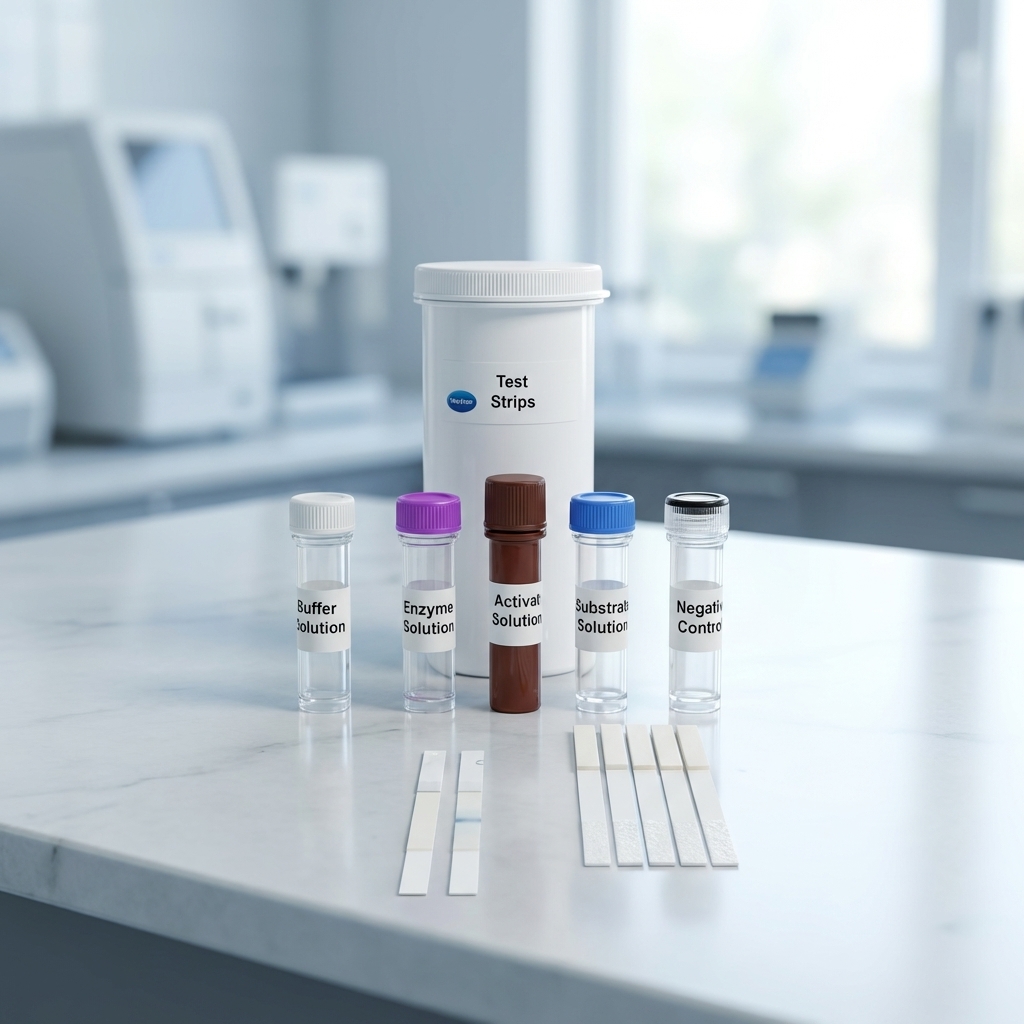
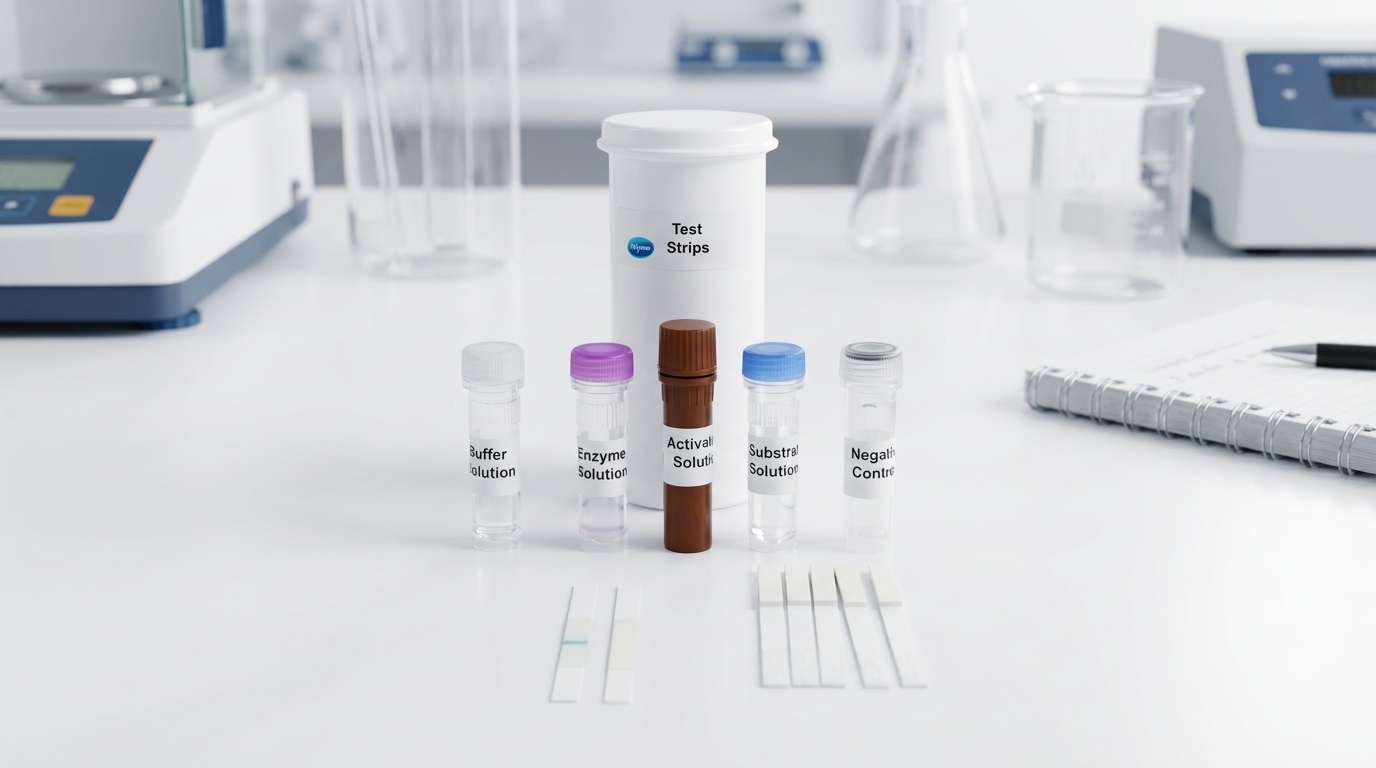
Each pesticide detection strip test kit includes:
- Test Strips, 24
- Enzyme Solution, 300 µL
- Activator Solution, 500 µL
- Buffer Solution, 500 µL
- Substrate Solution, 500 µL
- Negative Control, 1400 µL
- 96-well Microplate, 1
Store the kit at -15 to -25 °C. It can also be stored at 2–8 °C for up to 3 months after receipt.
You will also need: a pipettor and pipette tips, a timer, and tweezers or forceps.
Who It’s For
- Drinking water and agricultural water monitoring programs
- Produce residue screening and food safety programs
- Environmental monitoring of surface water and groundwater
- Research and educational laboratories
- Field teams that need a screening result without access to GC-MS or LC-MS/MS
How to Use the Pesticide Detection Strip Test
Before you start, let a frozen kit warm to room temperature for at least 90 minutes (at least one hour if stored at 2–8 °C). Handle each strip by the upper wick and avoid touching the lower pad.
- Add 200 µL of sample or Negative Control to the microplate wells.
- Add 10 µL of Activation Solution, mix, and incubate 10 minutes at room temperature.
- Add 10 µL of Buffer Solution, mix, and incubate 5 minutes.
- Add 10 µL of Enzyme Solution, mix, and incubate 10 minutes.
- Immerse the lower end of a strip in each well and incubate 10 minutes while the liquid flows up the membrane.
- Remove the strips, lay them pad side up, and remove the wick and sample pad with tweezers.
- Add 20 µL of Substrate Solution to the center of the membrane and incubate 5 minutes.
- Compare the test line intensity of each sample strip with the Negative Control strip.
If phosphorothioate and phosphorothionate pesticides are known not to be present, the activation step can be skipped. Full details are in the AU2070 instruction manual (PDF) and the technical article (PDF).
How It Works and Reading Results
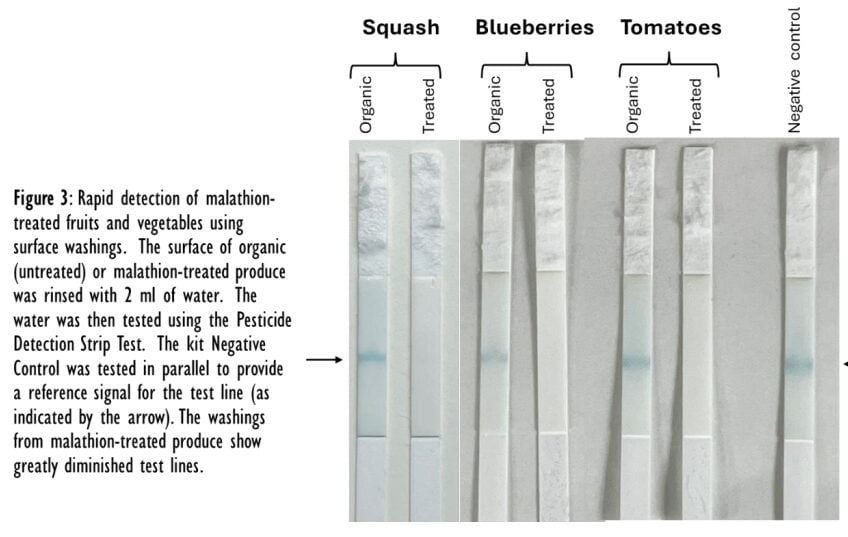
Organophosphate and carbamate pesticides act by inhibiting acetylcholinesterase. The enzyme in this kit is acetylcholinesterase derived from the cattle tick Rhipicephalus (Boophilus) microplus. In this test, any OP&C compounds in the sample bind and inhibit the enzyme. As the mixture flows up the strip, the enzyme is captured and concentrated at the test line. The Substrate Solution then produces a blue color wherever active enzyme remains.
- Negative (no inhibitor): a strong blue line matching the Negative Control.
- Low concentration: a visible but noticeably fainter line than the Negative Control.
- High concentration: little or no color at the test line. For example, 40 ppb chlorpyrifos completely inhibits the enzyme.
Record the result 5 minutes after adding the substrate, as color can continue to change. For related enzyme-based formats, see the Total Organophosphate Residue Detection Kit (Tick-Derived AChE) and the Total Organophosphate Residue Detection Kit (Eel-Derived AChE). For laboratory immunoassay testing, see the Organophosphorus ELISA Kit.
Frequently Asked Questions
Which pesticides does the pesticide detection strip test detect?
It detects organophosphate and carbamate pesticides that inhibit acetylcholinesterase, including malathion, diazinon, chlorpyrifos, parathion and coumaphos. Detection limits differ by compound, depending on how strongly each inhibits the enzyme.
How sensitive is the test?
It detects low levels (below 10 ppb) of common OP&C pesticides in water and other liquid samples. Sensitivity can be increased by extending the enzyme incubation step beyond 10 minutes.
What sample types can I test?
The test is recommended for water and other aqueous samples containing less than 20% miscible organic solvent. Other matrices, such as produce extracts, should be validated, and pigmented samples may obscure the color. Contact support@attogene.com for sample preparation methods.
Is the result quantitative?
The pesticide detection strip test is semi-quantitative. If only one known pesticide is present, it can be used with appropriate standards for quantitative testing. Confirm positives by HPLC or mass spectrometry as needed.
How long does the test take?
The manual protocol includes about 40 minutes of room-temperature incubations, or about 30 minutes when the activation step is not needed.
For research use only. Not for use in diagnostic procedures. Questions? Call 512-333-1330 or email sales@attogene.com.


