




The Attogene Universal Nucleic Acid ELISA Kit (EL2054) is a 96-well, plate-based method for colorimetric detection and calibration-based quantification of dual-labeled nucleic acids generated by PCR, RT-PCR, LAMP, RPA and related amplification reactions. Hapten-labeled amplicons are captured on an antibody-coated plate and detected with a biotin-streptavidin HRP system and TMB substrate, with absorbance read at 450 nm.
Choose the capture format when you order: Anti FAM/FITC (Kit 01, EL2054-01) for FAM/FITC-labeled products or Anti Dig (Kit 02, EL2054-02) for digoxigenin-labeled products. The test procedure is generally completed in about 60 minutes, and the dynamic detection range is 10 to 760 attomoles/µL for FAM/FITC and 10 to 920 attomoles/µL for digoxigenin using a 50 µL sample.
Key Features
- Two capture formats: Anti-FAM/FITC coated plate (Kit 01) or anti-digoxigenin coated plate (Kit 02), each with matching dual-labeled standards.
- Calibration standards included: Six dual-labeled control nucleic acid standards per kit, including a zero standard, for building a standard curve.
- Simple workflow: Sample and streptavidin-HRP detection reagent go into the well together for a single 30-minute incubation, followed by a 15-minute TMB step.
- Standard instrumentation: Reads on a standard ELISA plate reader at 450 nm; no fluorescent probes or electrophoresis required.
- Nuclease-free sample diluent: Supplied for diluting amplification products before loading.
What’s in the Kit
Each nucleic acid ELISA kit includes:
- Anti-FITC/FAM (Kit 01) or anti-Dig (Kit 02) coated 96-well plate, 1
- ELISA 20X Wash Solution, 28 mL
- Control Nucleic Acid Standards (biotin + FAM for Kit 01, or biotin + DIG for Kit 02), 6 vials x 800 µL
- 100X Detection Reagent (HRP-conjugated streptavidin), 250 µL
- Detection Reagent Dilution Buffer, 12 mL
- Nuclease Free Sample Diluent, 28 mL
- TMB Substrate Solution, 12 mL
- Stop Solution, 12 mL
- Manual
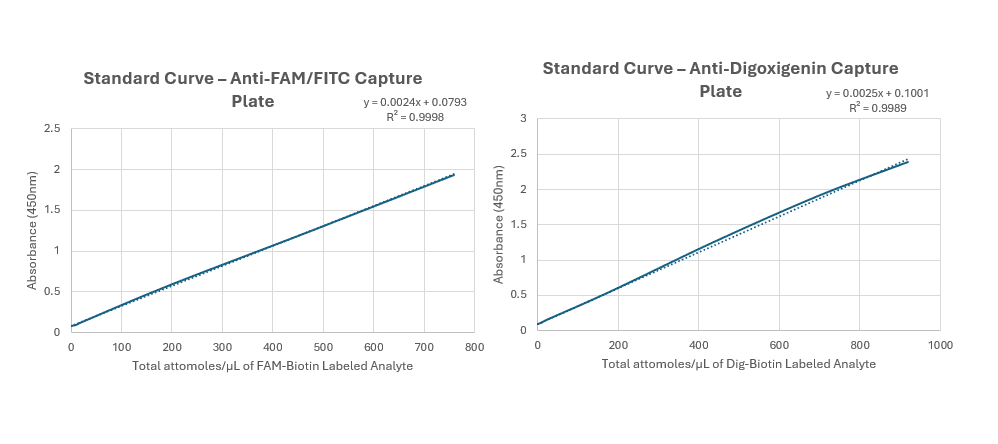
Standard concentrations are 0, 180, 300, 540, 640 and 760 attomoles/µL for the FAM/FITC kit and 0, 160, 340, 520, 700 and 920 attomoles/µL for the digoxigenin kit. Store the kit refrigerated until use and keep the antibody-coated plate in its desiccated bag until you are ready to run it.
You will also need: amplified nucleic acid samples made with dual-modified primers (hapten plus biotin), an ELISA reader (450 nm/630 nm) such as our Chromate 4300 microplate reader, deionized water, a vortex mixer, timer, wash bottle, absorbent paper, 20 to 200 µL and 100 to 1000 µL micropipettes, and a 300 µL multichannel pipette.
Who It’s For
- Molecular biology labs that want an endpoint readout for PCR, RT-PCR, LAMP or RPA without gels or probe-based fluorescence
- Assay developers optimizing amplification conditions and comparing primer sets or reaction formats
- Researchers running DNA-binding protein or hybridization assays
- Groups screening enzymatic activity and inhibition, or testing nuclease activity
- Labs that already own a standard ELISA plate reader and want to use it for nucleic acid work
How to Use the Nucleic Acid ELISA Kit
Primers must be designed so the final amplification product carries both labels: biotin plus FAM/FITC for Kit 01, or biotin plus digoxigenin for Kit 02. The manual procedure, in summary:
- Prepare. Bring all reagents and the plate to room temperature (20 to 28°C) for at least 30 minutes. Make 1X Wash Solution (1 volume of 20X Wash Solution plus 19 volumes of deionized water) and fresh 1X Detection Reagent (1 volume of 100X Detection Reagent plus 99 volumes of diluent, vortexed for 10 seconds).
- Plan the plate. Number the wells and run standards, a negative control and samples in duplicate. Dilute samples in Nuclease Free Sample Diluent as needed.
- Load. Add 50 µL of standard, negative control or sample to each well, then 100 µL of 1X Detection Reagent.
- Incubate. Shake gently for 30 seconds, cover, and incubate for 30 minutes at room temperature out of direct sunlight.
- Wash. Decant, wash three times with 250 µL of 1X Wash Solution per well, then blot the plate on absorbent paper.
- Develop. Add 100 µL of TMB Substrate Solution, mix gently, cover and incubate for 15 minutes at room temperature.
- Stop and read. Add 100 µL of Stop Solution, mix gently, and read absorbance at 450 nm within 5 minutes.
Plot absorbance against standard concentration on a semi-log scale, read sample concentrations from the curve and multiply by the sample dilution factor. Do not let wells dry out between steps. Full instructions are in the Universal Nucleic Acid ELISA Kit manual.
Assay Principle and Performance
The kit works as a dual-labeled sandwich ELISA. The hapten label (FAM/FITC or digoxigenin) introduced by one modified primer binds the anti-hapten antibody on the plate, and the biotin introduced by the other primer binds the streptavidin-HRP detection reagent. HRP converts TMB into a colored product, so signal increases with the amount of dual-labeled nucleic acid in the well.
Samples above the top standard should be diluted further, and a standard curve should be run with each set of samples. If you want to build your own assay instead, the same capture surfaces are sold separately as anti-FITC coated ELISA plates and anti-DIG coated ELISA plates, alongside streptavidin coated ELISA plates, goat anti-rabbit coated ELISA plates and the ELISA development starter kit. To check biotin labeling of your own reagents, see our biotin (vitamin B7) quantification kits.
Frequently Asked Questions
What samples can I run in the nucleic acid ELISA kit?
DNA or RNA amplification products, typically from PCR, RT-PCR, LAMP or RPA, that carry both a biotin label and either a FAM/FITC label (Kit 01) or a digoxigenin label (Kit 02).
Which version should I order, Kit 01 or Kit 02?
Match the kit to the hapten on your primer. Kit 01 has an anti-FAM/FITC coated plate and FAM standards; Kit 02 has an anti-digoxigenin coated plate and DIG standards.
How long does the assay take?
The test procedure is generally completed in about 60 minutes, including a 30-minute detection incubation and a 15-minute TMB step.
What is the detection range?
The dynamic detection range of the nucleic acid ELISA kit is 10 to 760 attomoles/µL for FAM/FITC and 10 to 920 attomoles/µL for digoxigenin, with a 50 µL sample volume.
For research use only. Not for use in diagnostic procedures. Questions? Call 512-333-1330 or email sales@attogene.com.


