

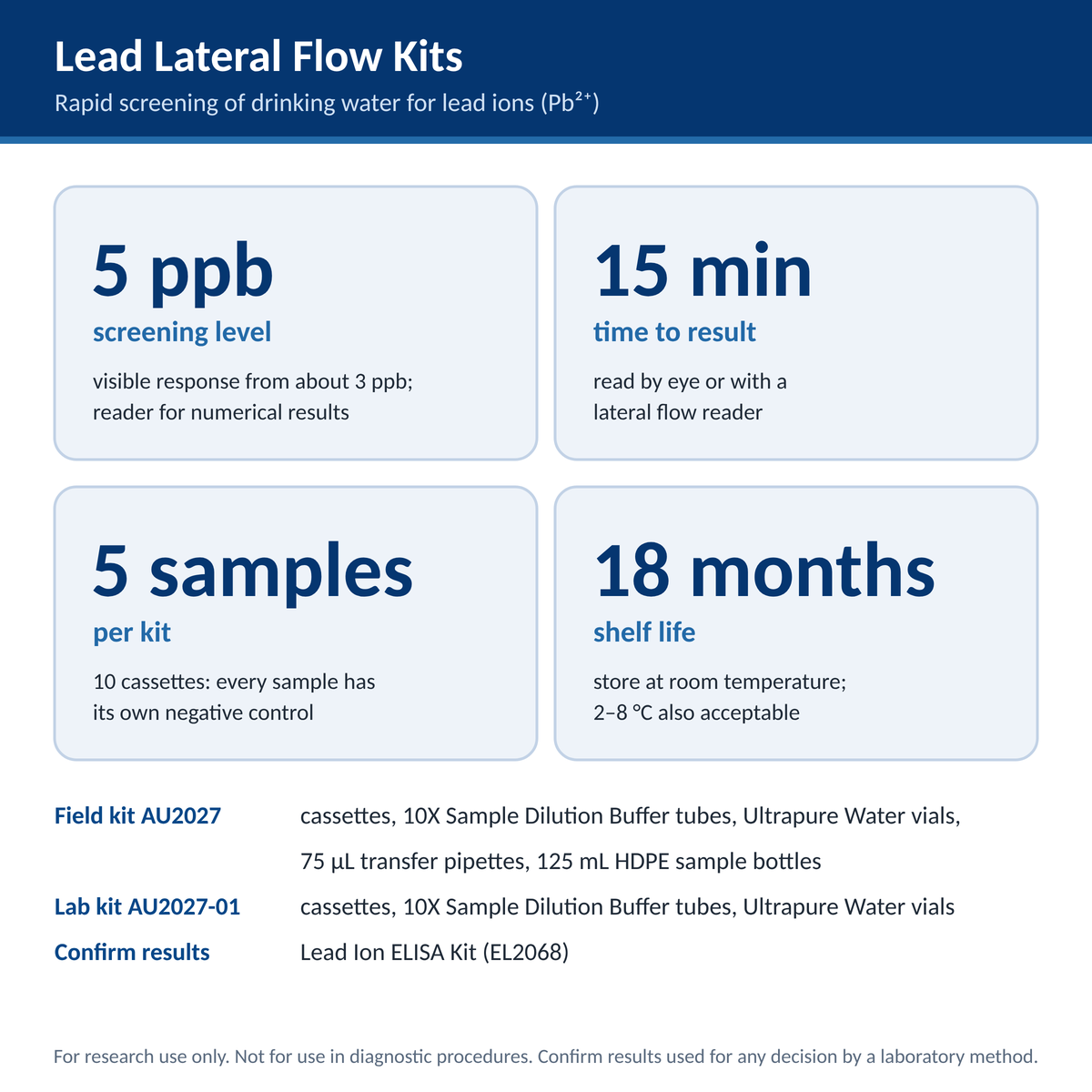
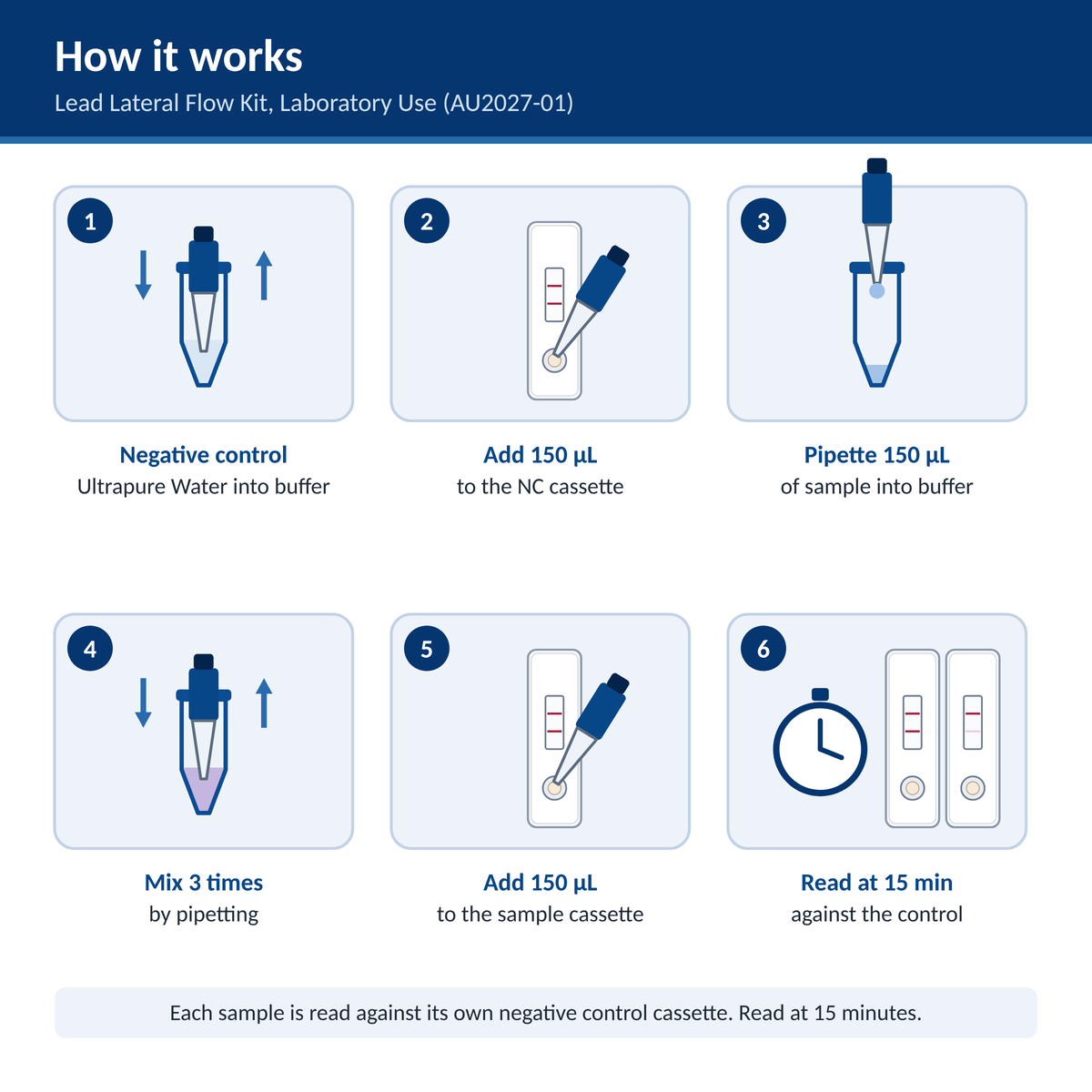


The Lead Detection Kit (Rapid – Lab) is a lead rapid test for screening water samples for lead at 5 ppb and above in a laboratory setting. The standard kit contains 10 lateral flow cassettes, enough for 5 samples each run beside its own negative control, with results read at 15 minutes.
Unlike the field kit, this lab version (catalog AU2027-01) is intended for technical users who already have pipettes and sample containers. It contains only the cassettes, Sample Dilution Buffer and negative-control water, which keeps the cost per test lower for routine batch screening. The manual states that results conform to the US EPA guideline of 15 ppb for lead in public drinking water systems.
Key Features
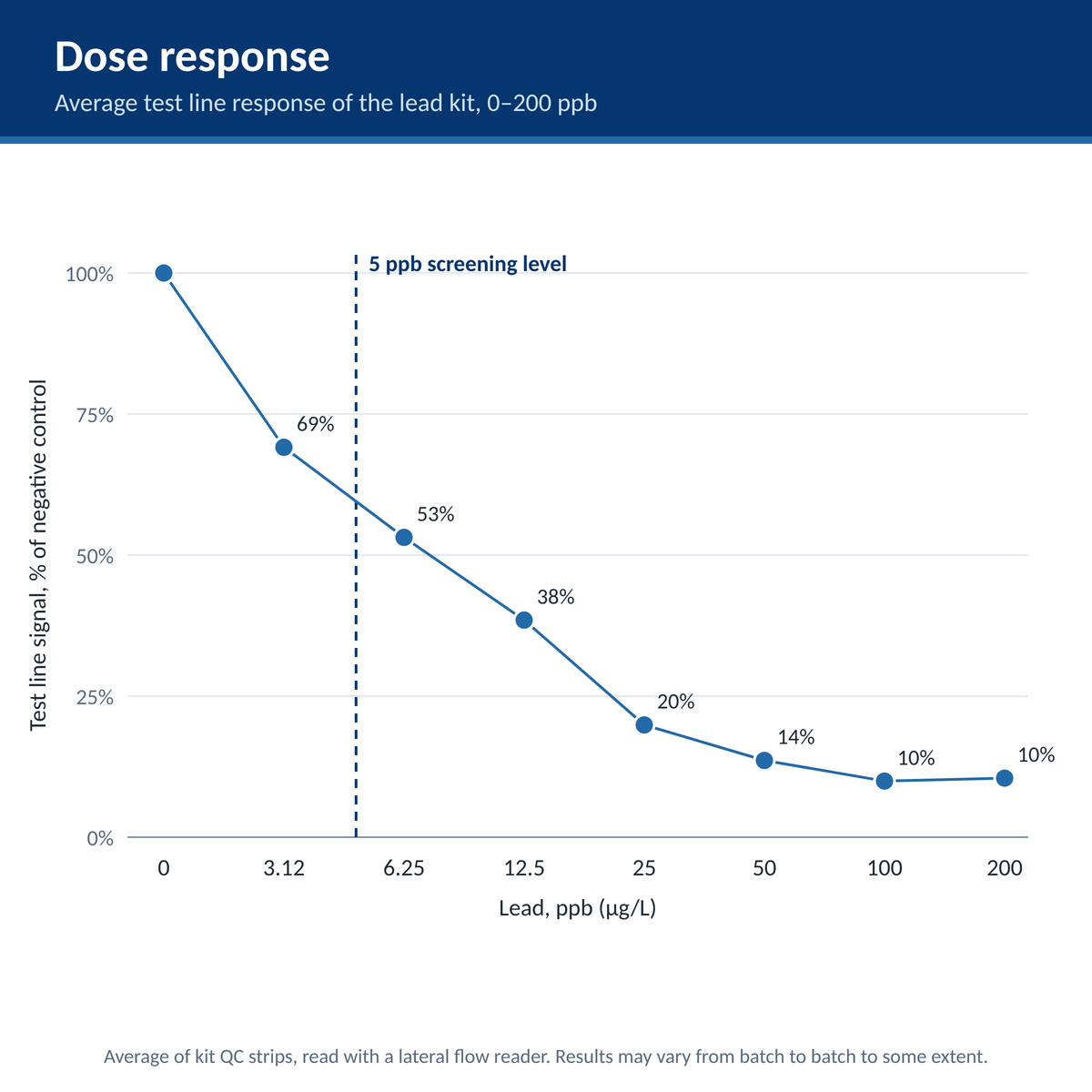
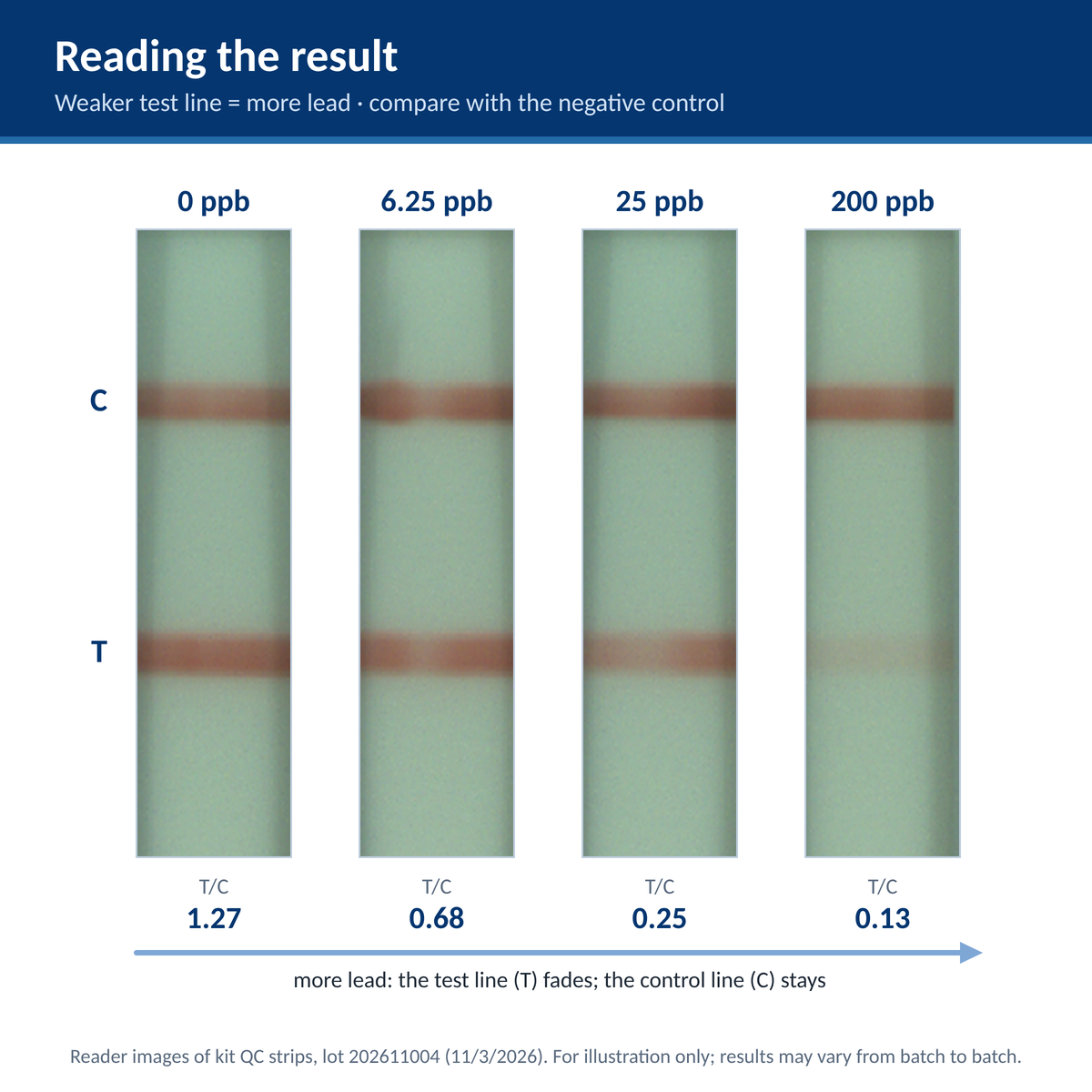
- Screening level: a lighter test line indicates lead at 5 ppb or higher; no test line indicates 50 ppb or higher.
- 15-minute read: start the timer after the sample and control are applied, then read both cassettes.
- Paired negative control: every sample is compared against a control cassette run at the same time.
- Lab-friendly format: a simple 150 µL pipetting step into a pre-filled buffer tube.
- Semi-quantitative option: run lead standards alongside samples to estimate concentration in the 0 to 20 ppb range.
- Reader compatible: a lateral flow reader can generate numerical readings from the visual result.
- Room-temperature storage: keep cassettes in their sealed foil pouches until use.
What’s in the Kit
Each lead rapid test kit includes:
- 10 lead test cassettes, each in a foil pouch with desiccant
- 10 Sample Dilution Buffer tubes
- 5 tubes of ultrapure water for the negative controls
- Instruction manual
You will also need: a timer, transfer pipettes, sample collection bottles and filters for turbid samples. Lead standards of known concentration are optional for positive controls or concentration estimates. This page also offers 5-test and 20-test sizes.
Who It’s For
This lead rapid test suits environmental, water utility, university and contract testing laboratories that screen many samples and want a quick triage step before instrumental analysis. Staff should be comfortable with pipetting and with handling samples according to lab practice.
For testing on site without lab equipment, choose the Lead Detection Kit (Rapid – Field Use), which adds sample bottles and disposable pipettes. For quantitative lead results, use the Lead Ion ELISA Kit.
How to Use the Lead Rapid Test
Collect samples in a clean bottle and refrigerate for up to 5 days, or freeze them if they must be held longer. Bring cassettes, buffer and samples to room temperature before testing.
- Open two sealed cassettes for each sample: one for the sample and one for the negative control.
- Sample: pipette 150 µL of the water sample into a Sample Dilution Buffer tube and mix by pipetting up and down 3 times. Add the diluted sample to the sample port of the first cassette.
- Negative control: pipette 150 µL of the supplied ultrapure water into another buffer tube, mix thoroughly, and dispense the entire volume into the sample port of the second cassette.
- Set a timer for 15 minutes, then read both cassettes side by side.
See the Lead Lateral Flow Rapid Lab Use Manual (AU2027-01) for full instructions.
Reading and Confirming Results
A visible control line is required on both cassettes for a valid result. Compare the sample test line with the negative control test line:
- Below 5 ppb: the sample test line is as dark as, or darker than, the control test line.
- 5 ppb or higher: the sample test line is lighter than the control test line.
- 50 ppb or higher: no test line; only the control line is visible.
Read within the stated time, because line intensity changes as the strip dries, and do not compare against strips run earlier. Positive samples can be confirmed by conventional methods such as instrumental analysis.
Frequently Asked Questions
What is the detection limit of the lead rapid test?
The lead rapid test screens water at 5 ppb and above. A missing test line indicates about 50 ppb or more.
Can I get a concentration from this kit?
The kit is qualitative. For approximate values between 0 and 20 ppb, run lead solutions of known concentration with your samples and compare line intensities. For quantitative results, use an instrumental method or the Lead Ion ELISA Kit.
Which sample types are supported?
The manual’s intended use is water samples. The manual also references FDA draft action levels for lead in juice; contact Attogene before testing juice, soil or other matrices, as these require their own sample preparation and validation.
Why is there no pipette or sample bottle in the kit?
The lab kit assumes you have standard pipettes and sample containers. If you need those supplied, use the field version of the kit.
How should the kit be stored?
Store the kit at room temperature and keep each cassette in its sealed pouch until you are ready to test. Check the expiration date before use.
Related lab kits for other metals include the Mercury Detection Kit (Rapid – Lab) and the Cadmium Detection Kit (Rapid – Lab).
For research use only. Not for use in diagnostic procedures. Questions? Call 512-333-1330 or email sales@attogene.com.


