

How Lateral Flow Assays Deliver Field-Ready Rapid Detection
Lateral flow assay kits have become the go-to detection platform for scientists, environmental agencies, food safety laboratories, and field teams that need fast, reliable results without the overhead of a fully equipped lab. Whether you are screening recreational water for cyanotoxins, verifying reagent quality in a molecular biology workflow, or developing a new immunoassay from scratch, a well-designed lateral flow assay delivers results in minutes from a compact, portable strip format. Attogene offers one of the broadest lateral flow assay portfolios available, spanning universal development kits, analyte-specific rapid tests, nucleic acid lateral flow systems, and enzyme contamination assays — all backed by validated reagents and field-proven performance.
What Is a Lateral Flow Assay and How Does It Work?
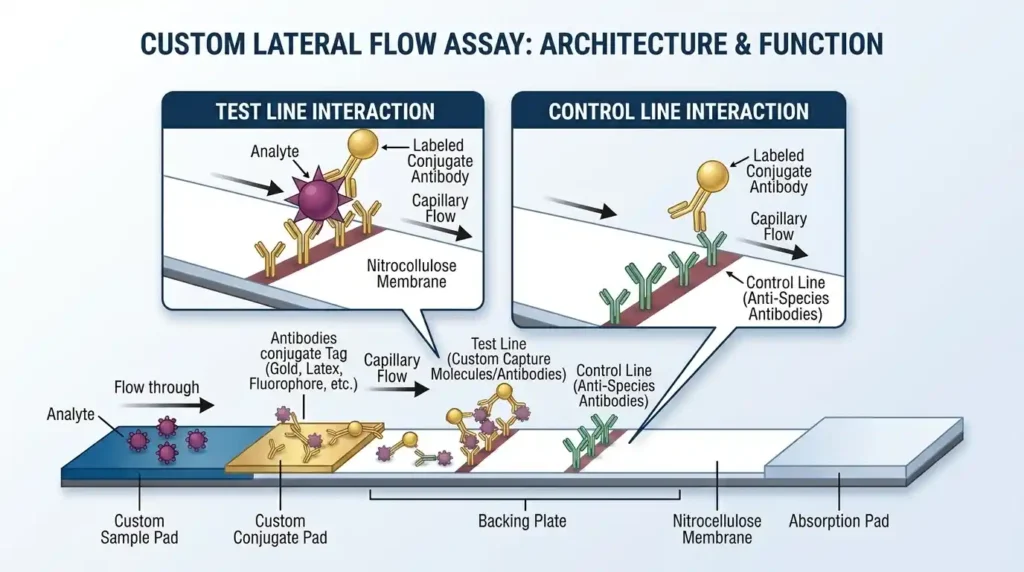
A lateral flow assay (LFA) — also called a lateral flow immunoassay or rapid test strip — is a paper-based diagnostic platform that detects the presence or absence of a target analyte in a liquid sample. The sample is applied to the strip and migrates by capillary action through several functional zones: a conjugate pad containing labeled detection antibodies or probes, a nitrocellulose membrane with immobilized capture antibodies at the test and control lines, and an absorbent pad that drives flow.
In a competitive lateral flow format — common for small molecule detection such as toxins, heavy metals, and contaminants — the absence of a test line indicates a positive result, while two lines indicate a negative. In a sandwich format — used for larger targets such as antigens and proteins — the presence of a test line indicates a positive. Results are typically visible within 5 to 15 minutes and require no instrumentation, making lateral flow assays ideal for field deployment, point-of-care screening, and high-throughput lab workflows alike.
Lateral Flow Assay Advantages Over Traditional Lab Methods
Traditional laboratory-based methods such as ELISA, mass spectrometry, and HPLC provide excellent sensitivity and quantitative data, but they require trained personnel, expensive instrumentation, extended turnaround times, and centralized laboratory infrastructure. Lateral flow assays complement these methods by enabling rapid screening at the source — on the water, in the field, at the processing facility, or directly in the collection environment.
Key advantages of lateral flow assays include minimal sample preparation, no cold-chain instrumentation requirement, results readable by eye or with a simple strip reader, low per-test cost at scale, and stability under a wide range of storage conditions. For government agencies conducting HAB surveillance, aquaculture operators monitoring shellfish toxin loads, and food safety labs screening incoming ingredients, lateral flow assay kits reduce the time from sample to decision from days to minutes.
Attogene Universal Lateral Flow Assay Kits for Assay Development
Researchers and assay developers building new lateral flow immunoassays need reliable, validated platform components before they can optimize for a specific analyte. Attogene’s universal lateral flow assay kits provide everything needed to get a new assay up and running quickly, with a consistent foundation that eliminates variability in conjugate quality and strip performance.
Universal Platform Kits
The AU2034 Universal Lateral Flow Assay Kit (Strep Gold) is Attogene’s flagship development platform, providing streptavidin-conjugated colloidal gold particles, pre-assembled lateral flow strips, and running buffer optimized for biotinylated antibody and probe systems. It is the recommended starting point for researchers developing new competitive or sandwich lateral flow immunoassays targeting small molecules, proteins, or environmental analytes.
For teams working with FAM- or FITC-labeled probes — including nucleic acid detection workflows — the AU2034 Universal Lateral Flow Assay Kit (anti-FAM Gold) provides an anti-FAM conjugated gold particle system optimized for lateral flow nucleic acid hybridization applications. Both kits pair with the AU2059 Lateral Flow Starter Kit, which bundles components and protocols designed to accelerate assay development from concept to prototype.
Nucleic Acid Lateral Flow Systems
Attogene’s nucleic acid lateral flow (NALF) products extend the lateral flow assay platform into molecular detection workflows. The AU2061 On-Strip Nucleic Acid Hybridization Lateral Flow Starter Kit provides a complete system for detecting PCR or LAMP amplicons directly on a lateral flow strip without the need for a plate reader or fluorescence instrument. The AU2065 Nucleic Acid Lateral Flow Barcode Test Strips provide multiplexed detection capability for workflows requiring simultaneous identification of multiple targets on a single strip.
Field-Deployable Lateral Flow Assay Kits for Environmental Monitoring
Environmental monitoring teams — including EPA field staff, state water quality agencies, aquaculture operators, and HAB response teams — require lateral flow assay kits that perform reliably in non-laboratory conditions. Attogene’s analyte-specific rapid test kits are validated for field use, requiring no electricity, no plate reader, and minimal sample handling before delivering a visual result.
Cyanotoxin and Algal Toxin Detection
Harmful algal bloom events produce a range of potent cyanotoxins that pose serious risks to recreational water users, drinking water systems, and aquatic ecosystems. The AU2024 Microcystin Rapid Test Kit is a field-deployable lateral flow assay for microcystin detection in recreational water, also available in a drinking water format (AU2024-02) and a lab-optimized format (AU2024-01). The AU2057 Saxitoxin PSP Lateral Flow Kit provides rapid detection of saxitoxin in freshwater streams and source water, with a companion shellfish-compatible format (AU2057-01) validated for aquaculture and PSP monitoring programs. Additional environmental kits include the AU2062 Anatoxin-a Detection Kit and the AU2058 Cylindrospermopsin Detection Kit.
Lateral Flow Assays for Enzyme Contamination and Reagent QC
One of the most underappreciated applications of lateral flow assay technology is reagent quality control in molecular biology labs. Nuclease contamination — particularly RNase and DNase — can silently degrade RNA and DNA samples, leading to failed experiments and wasted materials. Attogene’s enzyme activity lateral flow assays bring the speed and simplicity of a rapid test strip to nuclease detection workflows.
The AU2042 RNaseAlarm RNase Activity Assay detects RNase contamination in buffers, water, labware, and biological samples using a colloidal gold lateral flow format — delivering results in minutes without a fluorescence plate reader. The companion AU2056 DNaseAlarm DNase Activity Assay applies the same rapid lateral flow approach to DNase contamination screening, making both essential tools for qPCR, LAMP, sequencing, and cell-free expression workflows.
Choosing the Right Lateral Flow Assay Kit
Selecting the right lateral flow assay platform depends on several key factors: the target analyte, the sample matrix, the required detection threshold, whether the deployment environment is field or laboratory, and whether you need a ready-to-use kit or a development platform to build a custom assay.
For teams that need an off-the-shelf rapid test for a specific environmental or food safety target, Attogene’s analyte-specific kits — including microcystin, saxitoxin, aflatoxin, heavy metals, and staphylococcal enterotoxin B assays — provide validated, ready-to-run solutions. For researchers or assay developers who need a configurable platform, the universal kits and NALF starter kits provide the reagent foundation to develop and optimize a new assay quickly. View the complete Attogene product list to explore the full lateral flow assay portfolio, or contact Attogene to discuss your specific detection requirements.
Frequently Asked Questions
What is the difference between a lateral flow assay and an ELISA?
Lateral flow assays provide rapid, instrument-free results in 5 to 15 minutes and are ideal for field testing and screening applications. ELISA kits require a plate reader, more extensive sample processing, and longer incubation times, but deliver higher sensitivity and quantitative output. Many labs use both platforms together — lateral flow for rapid screening and ELISA for confirmation and quantification.
Can lateral flow assays detect nucleic acids?
Yes. Nucleic acid lateral flow (NALF) assays detect labeled PCR or LAMP amplicons on a test strip, providing a visual readout without fluorescence instrumentation. Attogene’s AU2061 On-Strip Nucleic Acid Hybridization Lateral Flow Starter Kit and AU2065 NALF Barcode Test Strips are designed specifically for these molecular detection workflows.
Are Attogene lateral flow assay kits field deployable?
Many Attogene lateral flow assay kits are validated for field use and require no electricity, instrumentation, or laboratory infrastructure. Field-deployable kits include the AU2024 Microcystin Rapid Test, AU2057 Saxitoxin PSP Lateral Flow Kit, AU2062 Anatoxin-a Detection Kit, and AU2058 Cylindrospermopsin Detection Kit, among others.
What is a universal lateral flow assay kit used for?
A universal lateral flow assay kit provides the core platform components — conjugated detection particles, lateral flow strips, and optimized running buffer — that researchers need to develop and validate a new lateral flow immunoassay for any target analyte. Attogene’s AU2034 Universal Lateral Flow Assay Kit and AU2059 Lateral Flow Starter Kit are widely used in assay development, antibody screening, and prototype optimization workflows.
How do lateral flow assays support reagent QC in molecular biology labs?
Attogene’s RNaseAlarm (AU2042) and DNaseAlarm (AU2056) lateral flow assays provide rapid, strip-based detection of RNase and DNase contamination in buffers, water, and labware. These kits deliver results in minutes without a plate reader, making nuclease contamination screening practical as a routine step before qPCR, LAMP, sequencing, or cell-free expression experiments.
