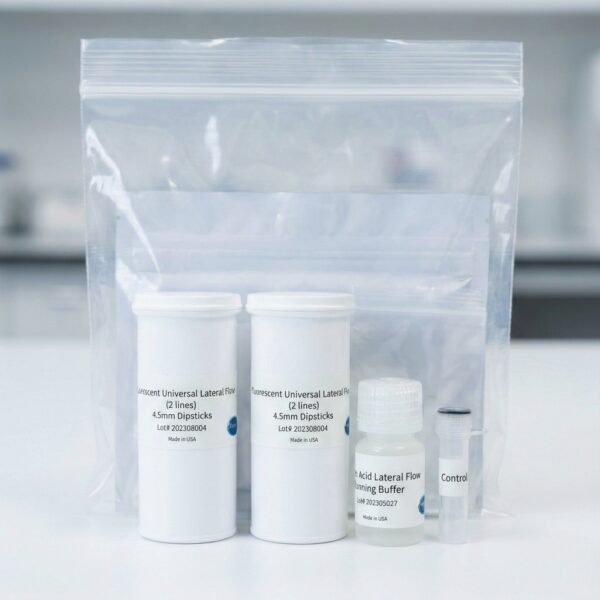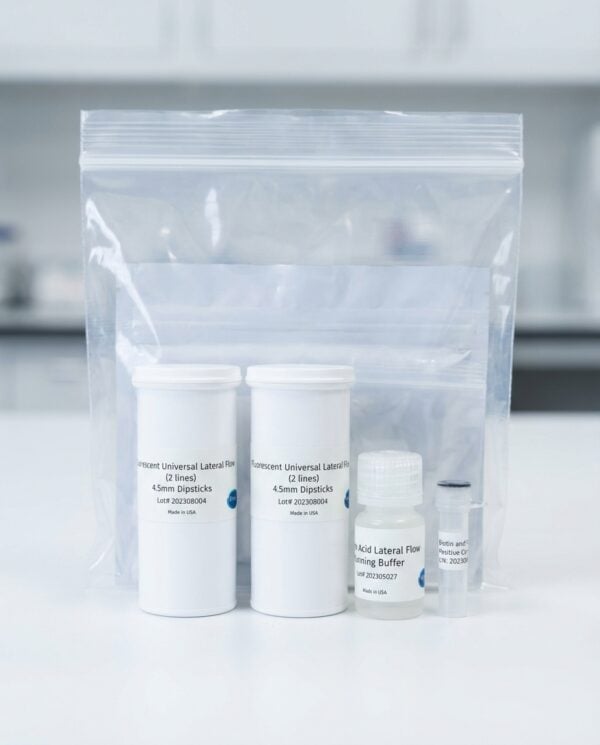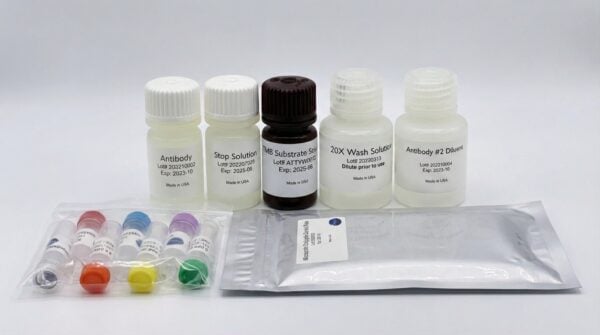


The “On Strip” Nucleic Acid Hybridization Lateral Flow Starter Kit (AU2061) is a nucleic acid lateral flow starter kit that gives you everything needed to attach a biotinylated oligonucleotide to a nitrocellulose strip and detect a complementary FAM/FITC-labeled probe by hybridization directly on the strip. The capture probe is anchored to the membrane through a biotin-streptavidin complex, and the hybridized detection probe is visualized with an anti-FAM/FITC colloidal gold conjugate.
The kit includes 100 blank lateral flow strips and enough reagents to run 100 “on strip” hybridization tests. Because spots are applied by pipette, researchers without spraying, laminating or cutting equipment can carry out much of their early nucleic acid lateral flow (NALF) development work in-house.
Key Features
- On-strip hybridization: Nucleic acid capture probes are immobilized on nitrocellulose and capture their complementary labeled strand as it flows past, an approach reminiscent of array-based detection.
- Optimized running buffer: Includes 15 mL of a specially formulated, RNase-free On-Strip Hybridization Buffer.
- Built-in controls: A biotinylated control capture oligonucleotide and a matching FAM-labeled control hybridization oligonucleotide let you verify your method before testing your own probes.
- Ready-to-spot control line: Goat anti-mouse (GAM) antibody is supplied ready to use and binds the anti-FAM/FITC gold to confirm the strip ran correctly.
- Bring your own probes: Use any user-supplied biotinylated capture probe and FAM/FITC-labeled hybridization probe in place of the controls.
- No equipment barrier: Spot 0.5 to 1 µL by pipette; no striping or lamination equipment is required.
What’s in the Kit
Each nucleic acid lateral flow starter kit includes:
- Streptavidin, 10 µL at 10 mg/mL (4 °C)
- Spotting Buffer, 100 µL (4 °C)
- Control Capture/Spotting Oligonucleotide, 5′ biotinylated, 5 µL at 100 µM (4 °C)
- Control Hybridization Oligonucleotide, 5′ FAM-labeled, 100 µL at 1 µM (4 °C)
- Anti-FAM/FITC Colloidal Gold, 1 mL (4 °C)
- RNase Free On-Strip Hybridization Buffer, 15 mL (room temperature)
- Goat Anti-Mouse control antibody, 100 µL, ready to use (4 °C)
- Blank Lateral Flow Strips, 100 (room temperature)
- 96-well plate, 1 (room temperature)
You will also need: a pipette able to dispense 0.5 to 1 µL, a 37 °C incubator or oven for drying spotted strips, a microcentrifuge to spin down low-volume tubes, and, if testing your own targets, a biotinylated capture oligonucleotide and a FAM/FITC-labeled hybridization probe.
Who It’s For
This nucleic acid lateral flow starter kit is designed for assay developers, academic labs and startups exploring nucleic acid detection on lateral flow, including readouts of upstream reactions such as LAMP, RPA, CRISPR, PCR or nuclease digestion. It is especially useful for teams who want to screen capture probe designs and optimize the amount of labeled hybridization probe needed for a visible signal before investing in sprayed or manufactured strips.
How to Use the Nucleic Acid Lateral Flow Starter Kit
- Spin down all tubes briefly, especially the low-volume streptavidin and control capture oligonucleotide.
- Prepare the capture spot: In spotting buffer, mix 10 to 25 pmol of biotinylated capture probe with 10 to 25 pmol of streptavidin at a 1:1 starting ratio. Adjust the ratio to find the optimum for your own probe. Suspending oligos at 100 µM makes dilution easier.
- Spot the strip: Apply 0.5 to 1 µL of the capture mixture to the lower section of a blank strip and 0.5 to 1 µL of the ready-to-use GAM control antibody to the upper section.
- Dry: Dry spotted strips at 37 °C for 30 minutes and store them dry until use.
- Set up the reaction: In a well of the 96-well plate, combine 150 µL of On-Strip Hybridization Buffer, about 1 pmol of control hybridization oligonucleotide (or your reaction mixture) and 10 µL of anti-FITC gold. Mix well.
- Run: Place the spotted strip in the well and let it run for about 30 minutes. Run time may vary with your hybridization probe and may need optimization.
Full instructions are in the AU2061 kit manual (PDF). Background data are available in the On-Strip Nucleic Acid Hybridization application note (PDF).
How On-Strip Hybridization Works
Most nucleic acid lateral flow assays rely on affinity tags such as biotin, FAM/FITC or DIG and antibody or streptavidin capture lines. On-strip hybridization instead immobilizes a nucleic acid capture sequence on the membrane. A FAM/FITC-labeled strand that is complementary to the capture probe hybridizes as it migrates through the spot, and the anti-FAM/FITC gold bound to that strand produces a visible signal. The GAM control spot captures the gold antibody regardless of the target.
Because each spot carries its own sequence, several capture probes can be placed on one strip. In Attogene’s application note, separate DNA and RNA detection probes produced specific signals at their own capture spots on a single strip.
Scaling Up and Customization
This kit is a starting point. For longer-term stability, Attogene offers custom conjugation of capture oligonucleotides to a BSA carrier protein, which forms a more stable conjugate that can be sprayed as lines or spotted for multiplex detection. Our custom lateral flow assay development services include capture probe spraying onto nitrocellulose cards and adjustment of overall test architecture. If you prefer tag-based detection, see the Universal Lateral Flow Assay Kit (FAM Gold) or the ready-made NALF barcode test strips.
Frequently Asked Questions
Can I use my own probes?
Yes. The nucleic acid lateral flow starter kit works with any user-supplied capture probe that carries a biotin and any hybridization probe labeled with FAM/FITC. The included control oligonucleotides help you confirm the method works first.
How many tests can I run?
The kit contains 100 blank strips and enough reagents for 100 on-strip hybridization tests.
How long does a test take?
After spotted strips are dried (30 minutes at 37 °C), the hybridization run typically takes about 30 minutes, though this can vary with your probe design.
Do I need lateral flow manufacturing equipment?
No. All reagents are applied by pipette as spots, so the nucleic acid lateral flow starter kit can be used in a standard molecular biology lab.
Can Attogene spray lines instead of spots?
Yes. For lines, additional capture probes or carrier-protein conjugated probes, contact Attogene about custom services.
How should the kit be stored?
Store the streptavidin, spotting buffer, oligonucleotides, gold conjugate and GAM antibody at 4 °C. The hybridization buffer, blank strips and 96-well plate are stored at room temperature.
For research use only. Not for use in diagnostic procedures. Questions? Call 512-333-1330 or email sales@attogene.com.