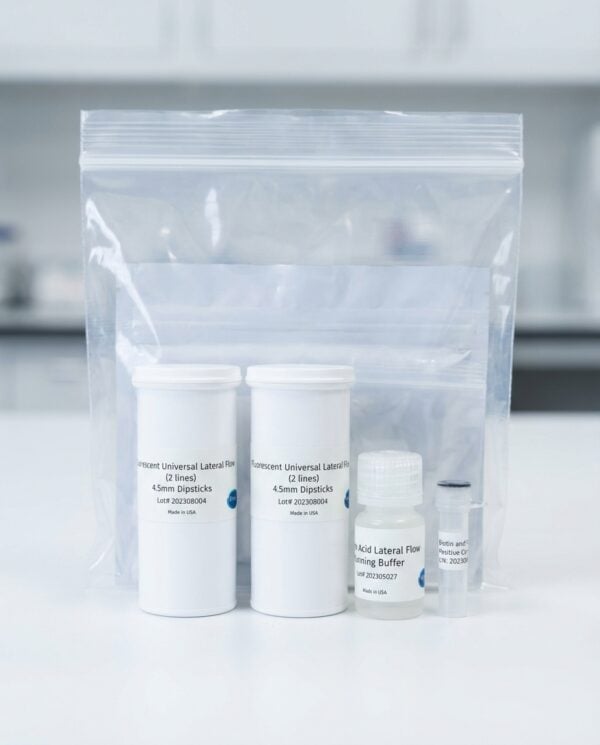


The Attogene Fluorescent Universal Lateral Flow Assay Kit (R-Phycoerythrin), AU2053, is a ready-to-use phycoerythrin lateral flow assay kit for quick, cost-effective development of fluorescent dipstick assays that detect labeled DNA and RNA products. Each kit includes 50 pre-made 4.5 mm dipsticks, nuclease-free running buffer, labeled control nucleic acid and a 96-well plate.
Detection uses streptavidin-conjugated R-phycoerythrin (R-PE), with excitation in the 545 nm to 566 nm range and emission at about 575 nm. Strips are read by eye under a black light or in a fluorescent lateral flow reader. Fluorescent lateral flow assays have been described as 2 to 100 times more sensitive than gold-based tests.
Key Features
- Universal format: Detects amplified DNA products from PCR, LAMP and RPA reactions, or any nucleic acid carrying biotin plus a second label.
- R-PE detection: Streptavidin R-phycoerythrin conjugate with roughly 575 nm emission.
- No striping required: Capture lines are pre-sprayed, so there is no need to stripe capture antibodies.
- Multiplex options: Available in 2-line, 3-line and 4-line configurations.
- Low equipment cost: No expensive equipment is needed for visual reads; a reader adds numerical output.
- Cost-effective screening: A practical way to screen designs before downstream lateral flow assay development.
What’s in the Phycoerythrin Lateral Flow Assay Kit
Each phycoerythrin lateral flow assay kit includes:
- 50 fluorescent lateral flow dipsticks, 4.5 mm (room temperature)
- 12 mL Nucleic Acid Lateral Flow Running Buffer, nuclease-free (room temperature)
- 20 µL control nucleic acid containing biotin and FAM (all versions; refrigerate or freeze)
- 20 µL control nucleic acid containing biotin and DIG (3-line and 4-line versions)
- 20 µL control nucleic acid containing biotin and DNP (4-line version only)
- One 96-well plate and manual
Store the kit at 2 °C to 30 °C and keep strips in the sealed foil pouch with desiccant until use.
You will also need: a timer, a centrifuge for preparing clear specimens, a pipettor and tips, tubes or microtiter plates, and your molecule of interest labeled with biotin plus FITC/FAM, DIG or DNP (depending on version).
Line Configurations
- 2-line (01 version): Test line anti-FITC/FAM; control line biotin.
- 3-line (02 version): Test line 1 anti-FITC/FAM, test line 2 anti-DIG, control line biotin.
- 4-line (03 version): Test line 1 anti-DNP, test line 2 anti-FITC/FAM, test line 3 anti-DIG, control line biotin.
When generating products by amplification, design primers so the final product carries both biotin and the test-line label.
Who It’s For
This kit is for researchers and assay developers who want a fluorescent readout for nucleic acid amplification without striping or cutting equipment, and who want to evaluate R-PE alongside other labels. It suits labs working with PCR, LAMP or RPA products, teams whose reader optics match the R-PE spectrum, and developers comparing fluorescent particles before building a custom test.
How to Use the Phycoerythrin Lateral Flow Assay Kit
- Add 150 µL of Nucleic Acid Lateral Flow Running Buffer to a well of the 96-well plate.
- Set up sample, positive and negative wells. For samples, add 1 to 5 µL of product as a starting point (try large dilutions on a first run and keep the volume below 15 µL if possible). For the positive control, add 5 µL of control oligonucleotide. Leave the negative control well with buffer only.
- Mix each well completely by pipetting up and down several times.
- Add one dipstick to each well, arrows facing up.
- Incubate for 15 to 30 minutes.
- Read right away by eye under a black light or in a fluorescent lateral flow reader. Phycoerythrin is sensitive to photobleaching, so immediate analysis gives the best results.
See the AU2053 kit manual (PDF) for full instructions.
Reading Results
Labeled nucleic acid binds the streptavidin R-PE conjugate and is captured at the matching test line. The higher the concentration of labeled product, the brighter the test line compared with a buffer-only strip. Free conjugate binds the biotin control line, so control line intensity decreases as the test line increases, which allows ratio analysis.
The stoichiometry between labeled nucleic acid and conjugate matters. If no test line appears, a serial dilution may be needed because of the hook effect. For higher analytical sensitivity, increase the volume or concentration of nucleic acid added. Positive samples can be confirmed by agarose or acrylamide gel analysis.
Performance on a Fluorescent Reader
In an Attogene technical study using a Lumos Diagnostics Leelu reader, two-line AU2053 strips detected titrated biotin/FAM control oligonucleotide with high specificity, with sensitivity slightly below the europium version on a reader built for europium optics. Details are in the Lumos Leelu technical article (PDF).
Frequently Asked Questions
How does R-PE compare with the other fluorescent versions?
The strip layout is the same as the quantum dot version and the europium version; only the fluorescent label and its spectrum differ. Pick the label that best matches your reader.
Why read the strips immediately?
Phycoerythrin is sensitive to photobleaching, so signal is best captured right after the run.
How long is the incubation?
The manual specifies 15 to 30 minutes. The positive control should give test and control line signal within 15 minutes.
Do I need a reader?
Not for visual screening, but a fluorescent reader is needed to reach the higher sensitivity described for fluorescent lateral flow assays and to get numerical readings from the phycoerythrin lateral flow assay kit.
Can the phycoerythrin lateral flow assay kit be customized?
Yes. It can be configured with alternative or custom streptavidin fluorescent particles and other line layouts. For a colorimetric option, see the gold Universal Lateral Flow Assay Kit, or explore our custom lateral flow assay development services.
For research use only. Not for use in diagnostic procedures. Questions? Call 512-333-1330 or email sales@attogene.com.