


Attogene Universal Loop-mediated isothermal amplification (LAMP) Lateral Flow Assay Kits are a convenient ready-to-use kits for quick and cost-effective development of a LAMP based lateral flow assay for detection of DNA and RNA products. Specifically optimized for LAMP reactions.
Formats (strep gold conjugate pad):
Detection of nucleic Acid (DNA or RNA) requires the use of a biotin and FAM-labelled primer during Loop-mediated isothermal amplification. Test line: anti-FITC/FAM, Control Line: Biotin Choose the option “2 Line'”
Multiplex detection of nucleic Acid (DNA or RNA) requires the use of:
Biotin, FITC/FAM and Dig labelled primers during Loop-mediated isothermal amplification.: Test Line #1: anti FITC/FAM, Line #2: anti-Dig, Line #3 Biotin. (multiplex up to two targets on a single lateral flow strip) Choose the option “3 Line'”
Biotin, FITC/FAM and Dig labelled primers during Loop-mediated isothermal amplification.: Test Line #1: anti-DNP, Test Line #2 anti FITC/FAM, Line #3: anti-Dig, Line #4 Biotin. (multiplex up to three targets on a single lateral flow strip) Choose option “4 Line”
2, 4-Dinitrophenol = (DNP)
Inquire about custom configurations: sales@attogene.com
Kit Components:
- 50 -4.5mm Lateral Flow strips designed with optimized sample pads provided in Cassettes
- 10 mL Sample LAMP optimized assay running buffer
- 20 uL Control
Features & Benefits:
- Can be used for development of a lateral flow assay for detection of a variety of different molecules such as amplified nucleic acid products from LAMP reactions with an added blood separation pad.
- No need to stripe capture antibodies
- No expensive equipment required
- Cost-effective way to screen for further downstream lateral flow assay development.
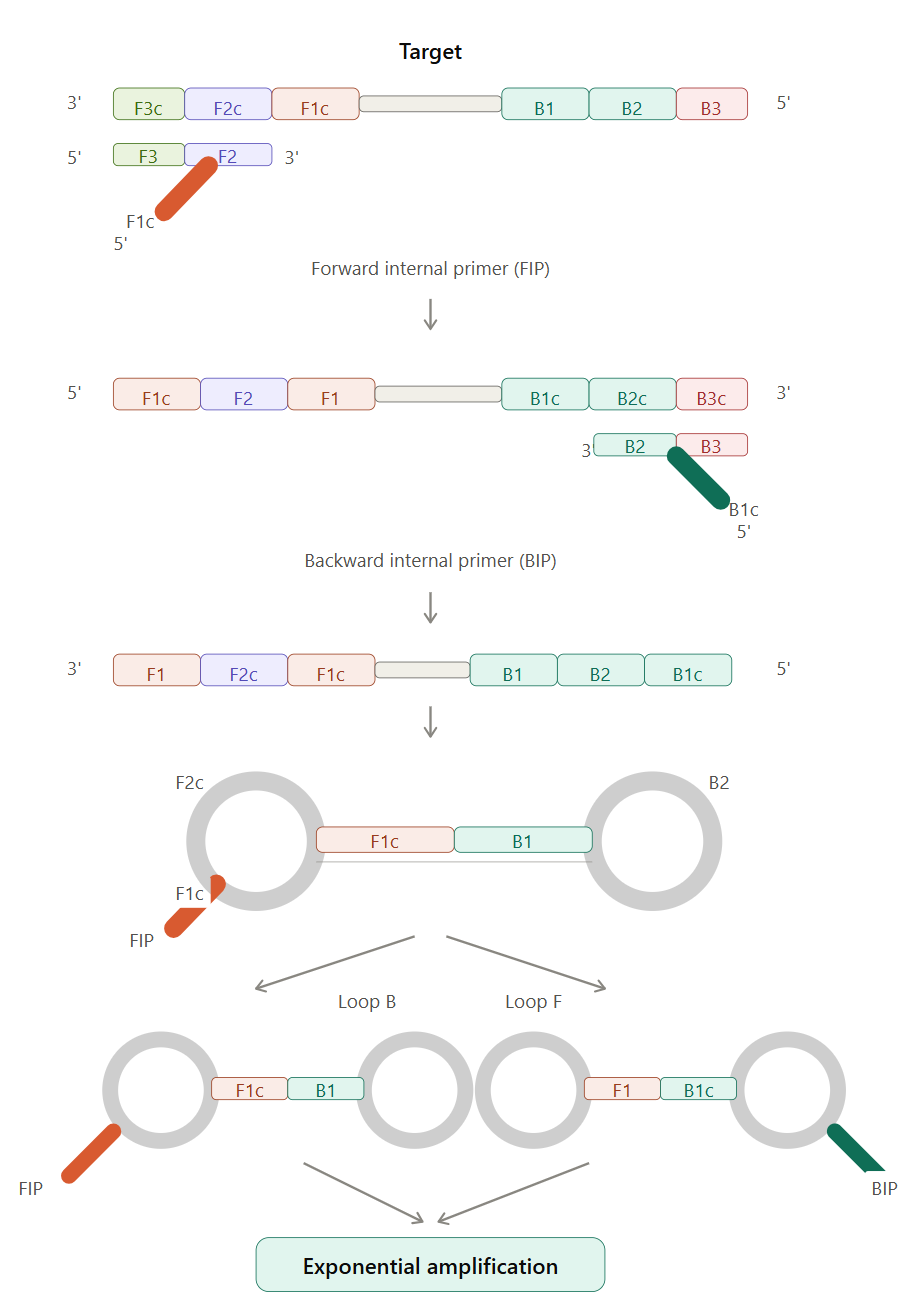
Primers shown in the diagram
| Primer | Composition | Where it appears |
|---|---|---|
| F3 | Single short primer | Bottom-left of Stage A — the outer forward primer, binds outside F2, initiates the first strand-displacement synthesis |
| B3 | Single short primer | Bottom-right of Stage B — the outer backward primer, binds outside B2c, displaces the FIP-synthesized strand |
| FIP (Forward Inner Primer) | F2 + F1c, joined | Shown twice — Stage A (initial annealing) and again as the diagonal flag on the Stage 4/5 loop structures. It’s a single oligo with two functional halves: the F2 segment anneals to the template, while the F1c tail becomes the sequence that later folds back to form the loop |
| BIP (Backward Inner Primer) | B2 + B1c, joined | Shown at Stage B, and again as the diagonal flag on the right-hand loop structures — same dual-function logic as FIP, mirrored |
Primers implied but not drawn in
The regions labeled “Loop B” and “Loop F” in the final dumbbell structures are where the loop primers (LB and LF) would bind — these are optional accelerator primers that speed up LAMP by giving the polymerase additional starting points on the single-stranded loops, rather than waiting for FIP/BIP alone to re-initiate each cycle. I labeled the loop regions but didn’t draw the LB/LF primers themselves annealing to them.
Summary — a standard LAMP reaction uses 4 core primers (F3, B3, FIP, BIP), optionally accelerated by 2 additional loop primers (LF, LB) — 6 total in the accelerated version.